
Marketers must constantly adapt to new tech. Admittedly, Traditional Search Engine Optimization (SEO) is still vital. However, a new player has joined the game. Specifically, this is Generative Engine Optimization (GEO).
AI platforms like ChatGPT, Google Gemini, and Perplexity are growing fast. Therefore, you need to know how GEO differs from SEO. Furthermore, using both strategies is key to your success.
What is SEO?
First, Search Engine Optimization (SEO) helps websites rank higher. Specifically, it targets results on search engines like Google, Bing, and Yahoo.
Ultimately, the main goal is to drive free traffic to your site. To do this, SEO improves your content and structure. For example, businesses want to appear at the top for searches. Consequently, they focus on keywords, links, and speed.
Historically, experts have built SEO on three main pillars:
- First, On-page SEO: This improves content, headers, and images.
- Second, Off-page SEO: This looks at outside factors. Primarily, it focuses on backlinks for authority.
- Third, Technical SEO: This fixes the backend. As a result, it ensures fast loading and mobile support.
Undoubtedly, SEO is a solid foundation. Yet, AI is moving fast. Consequently, SEO alone may not be enough anymore.
What is GEO?
In contrast, Generative Engine Optimization (GEO) is a new strategy. Primarily, it focuses on getting your brand mentioned in AI answers.
While SEO targets lists, conversely, GEO aims for mentions by chatbots. Specifically, it targets tools like ChatGPT and Gemini.
Moreover, these AI tools use smart technology to learn. Unlike Google, they don’t just list links. Instead, they pull facts from many places. For instance, they use websites, forums, and reviews.
Crucially, GEO looks beyond your website. In fact, it values third-party mentions of your brand. Specifically, these sources include:
- Social media
- Online communities
- Reviews and ratings
- Also, news articles and reports
Basically, the difference is clear. SEO ranks your site. However, GEO cites your brand. First, AI engines spot “entities” like brands. Then, they talk about them. As a result, a user might learn about you without visiting your site. So we should also focus on Ranking on Chatgpt and optimize content for Perplexity.
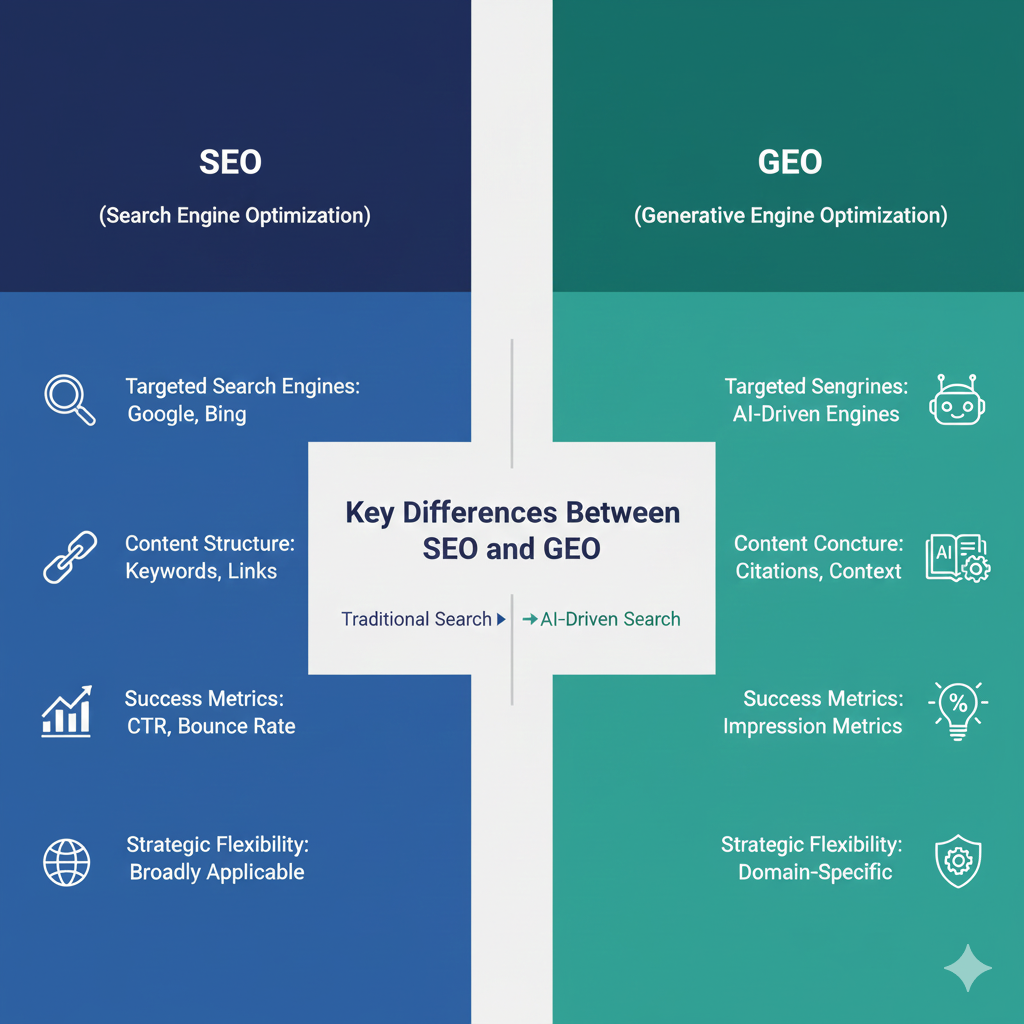
Comparison: SEO vs. GEO
| Feature | SEO (Search Engine Optimization) | GEO (Generative Engine Optimization) |
| Primary Goal | Rank #1 on Google. | Get mentioned by AI. |
| Target Audience | People searching on browsers. | People chatting with AI. |
| Key Metric | Clicks and Traffic. | Brand Mentions. |
| Content Focus | Keywords and Links. | Context and Facts. |
How GEO and SEO Relate
Although SEO and GEO are different, luckily they work well together. Actually, SEO builds a base for AI success.
1. Shared Basics
First, both methods need clarity and trust. Therefore, your website must be easy to read. Additionally, high-quality content helps both strategies.
2. Identifying Brands
Next, AI engines use “entity recognition.” Essentially, they look for real-world brands. Thus, good SEO builds authority. Consequently, when you link to good sources, AI engines trust you.
3. Mentions Off-Site
Finally, look off-site. While SEO fixes your website, on the other hand, GEO goes further. For instance, AI reads news sites. If people talk about your brand online, then AI notices. Ultimately, SEO builds your home base; meanwhile, GEO ensures AI talks about it.
Why GEO Matters
Because AI is changing how we search, therefore GEO is the future.
- First, AI is Popular: For example, millions use ChatGPT daily. As a result, users often skip Google links. Thus, you must appear in AI answers to compete.
- Second, Trust: Indeed, being mentioned by AI is powerful. If AI cites you often, then you grab attention without a search rank.
- Third, Wider Reach: Moreover, GEO spreads your name. Since AI looks at reviews, therefore you gain fans from many places.
The Best Strategy: Mix SEO and GEO
Instead of choosing just one, rather mix GEO into your SEO plan.
- First, Optimize for Both: Write great content. Also, keep it simple for AI.
- Next, Get Mentioned: Specifically, encourage people to talk about you. Consequently, more chatter leads to more citations.
- Finally, Watch Your Progress: Continually check how AI refers to you.
Conclusion
In summary, SEO and GEO are partners. While SEO ranks you on Google, conversely, GEO gets you cited by AI.
Therefore, both are needed for a strong presence. Ultimately, you should use both in your marketing. By doing so, you ensure you are seen everywhere.
So, focus on both SEO and GEO. Thus, you will be positioned to win in both traditional search and the new world of AI.
We at Buzzbaba specialize in both SEO and GEO.


Leave a Reply