For years, SEO has been the backbone of digital visibility.AI search engines are changing search. People now expect quick answers. As a result, many marketers are asking one question: Is SEO dead?
The short answer is no. Instead, SEO is evolving. Therefore, we are entering a new era known as GEO – Generative Engine Optimization.
- Understanding the “SEO Is Dead” Narrative
- What Is GEO (Generative Engine Optimization)?
- Why AI Search Engines Are Changing Everything
- SEO vs GEO: Key Differences
- Is Traditional SEO Still Relevant?
- How to Optimize Content for AI Search Engines (GEO)
- 1. Focus on Search Intent
- 2. Write Clear, Structured Content
- 3. Build Topical Authority
- 4. Use Natural Language
- 5. Demonstrate Experience & Expertise
- The Role of Content in the GEO Era
- Future of SEO: What Should Marketers Do?
- Final Thoughts: SEO Isn’t Dead — It Has Evolved
- FAQ’s Related to “is SEO dead?”
In this blog, we will explore why traditional SEO is changing, how AI search engines work, and, most importantly, how you can optimize your content for this new landscape.
Understanding the “SEO Is Dead” Narrative
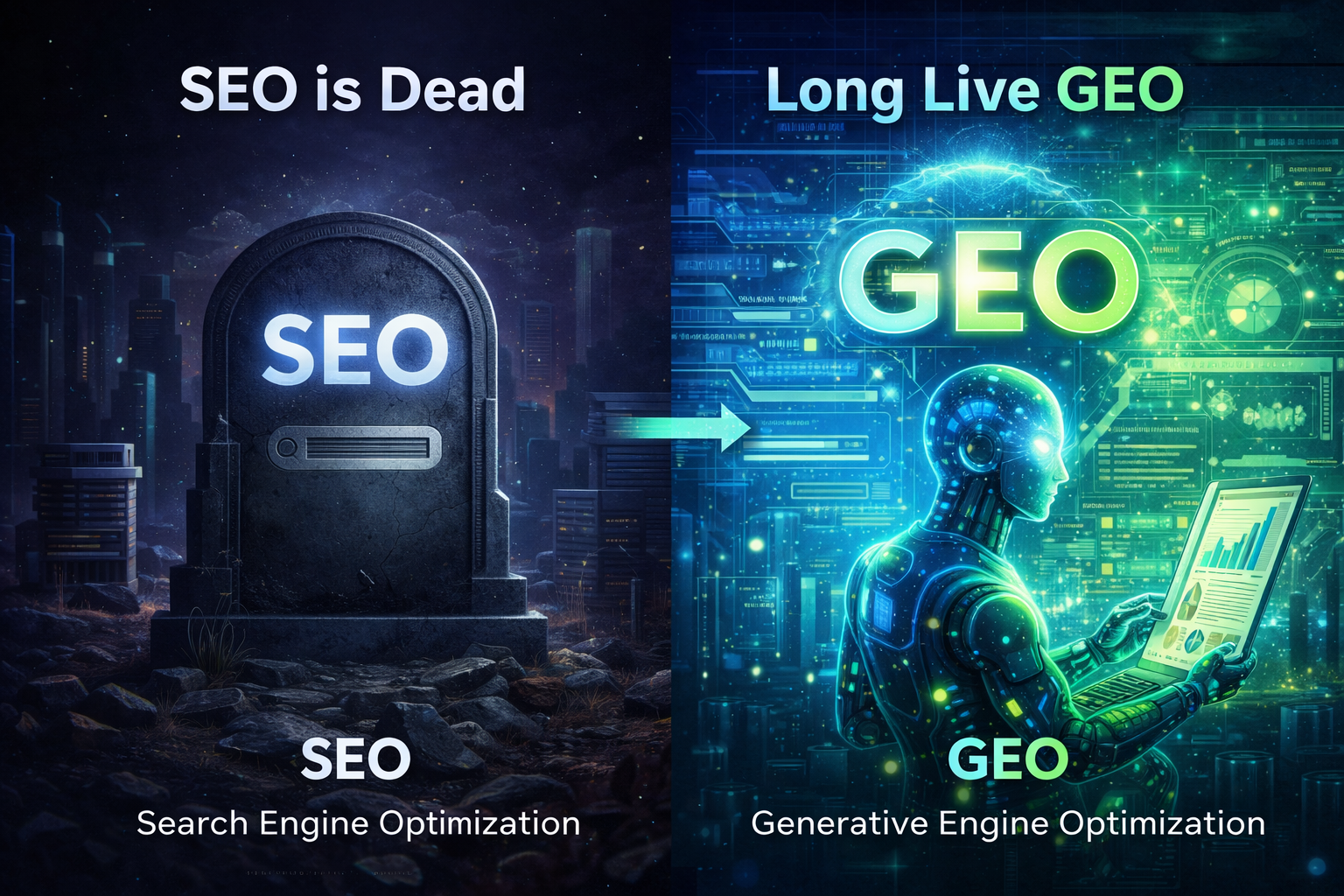
First of all, it’s important to clarify what people really mean when they say SEO is dead. In reality, SEO is not dead.
It is changing.
Previously, search engines focused heavily on:
- Keywords
- Backlinks
- Meta tags
However, today’s AI-driven platforms such as Google’s SGE, Bing AI, and ChatGPT-powered search experiences prioritize context, intent, and usefulness. As a result, traditional keyword stuffing no longer works.
Therefore, SEO is not dead. Old SEO practices are.
What Is GEO (Generative Engine Optimization)?
GEO stands for Generative Engine Optimization. It focuses on content AI uses. AI uses this content to answer questions. This is different from ranking pages alone.
Unlike traditional search engines that show ten blue links, AI search engines:
- Summarize information
- Combine multiple sources
- Provide direct answers
Moreover, these engines choose content that is clear, authoritative, and context-rich.
Simply put, SEO focused on rankings. GEO focuses on being cited by AI.
Why AI Search Engines Are Changing Everything
AI understands language better. It looks at meaning, not keywords. As a result, AI rewards content that feels human. It must also be helpful and well structured.
Additionally, AI engines prioritize:
- Semantic relevance
- Topical authority
- Conversational tone
Therefore, writing only for algorithms is not enough anymore. You must write for humans and machines simultaneously.
SEO vs GEO: Key Differences
Let’s also understand how SEO and GEO differ:
Traditional SEO focuses on:
- Exact-match keywords
- Page rankings
- Link-building strategies
GEO focuses on:
- Intent-based answers
- Entity recognition
- Structured, factual clarity
GEO needs better content. Thin content fails. Surface-level optimization no longer works.
Is Traditional SEO Still Relevant?
Yes — but with conditions.
Technical SEO still matters. This includes site speed, mobile optimization, and indexing. However, they are now the foundation, not the strategy itself. Moreover, without high-quality, AI-friendly content, technical SEO alone will not deliver results.
Therefore, the smartest approach combines SEO and GEO. It is not one versus the other.
How to Optimize Content for AI Search Engines (GEO)
1. Focus on Search Intent
Do not target one keyword. Answer real questions. For example:
- Why is SEO changing?
- How do AI search engines rank content?
As a result, your content becomes more valuable to AI models.
2. Write Clear, Structured Content
AI engines prefer content with:
- Short paragraphs
- Clear headings
- Logical flow
Moreover, lists help AI understand content. Bullet points work best. Numbered lists also make extraction easier.
3. Build Topical Authority
Rather than writing one article, create clusters of related content. Therefore, AI recognizes your site as a trusted source on the topic.
4. Use Natural Language
Avoid robotic keyword repetition. Instead, write conversationally.
For example, use phrases like:
- “In simple terms”
- “This means that”
- “As a result”
This helps AI understand and reuse your content.
5. Demonstrate Experience & Expertise
AI search engines prioritize E-E-A-T (Experience, Expertise, Authority, Trust).
Therefore:
- Share insights
- Use real examples
- Back claims with logic
This increases the chances of your content being cited by AI.
The Role of Content in the GEO Era
Content is no longer about ranking alone. Instead, it’s about being useful enough to quote.
Moreover, AI prefers content that:
- Solves problems
- Explains concepts clearly
- Avoids fluff
Therefore, long-form, well-structured blogs will outperform shallow articles.
Future of SEO: What Should Marketers Do?
Looking ahead, SEO experts must adapt. Change is fast.
Here’s what you should do:
- Combine SEO fundamentals with GEO strategies
- Invest in content quality, not quantity
- Stay updated with AI search developments
Additionally, testing and adapting will be crucial, as AI algorithms evolve rapidly.
Final Thoughts: SEO Isn’t Dead — It Has Evolved
To conclude, SEO is not dead. Instead, it has grown smarter.
GEO is the future of search. Content quality and clarity now matter more than ever. Therefore, early adopters will win.
Others will fall behind.
In short:
SEO is dead? No.
SEO is evolving — and GEO is the future.

Leave a Reply