
Search is changing faster than ever. Traditional search engines still matter, but AI tools like ChatGPT are now shaping how people discover information. Therefore, brands, bloggers, and businesses must adapt. Ranking on ChatGPT is quickly becoming the new frontier of SEO.
In this guide, you’ll learn how to rank on ChatGPT, why it matters, and what strategies actually work. Most importantly, we’ll keep things clear, practical, and easy to follow.
Why Ranking on ChatGPT Matters
ChatGPT does not work like Google. It does not show ten blue links. Instead, it gives direct answers. Therefore, if your content becomes a trusted source, ChatGPT may use it to shape responses.
Moreover, users now ask full questions instead of typing keywords. They want fast, accurate, and human-like answers. If your content solves problems clearly, it stands a better chance of being referenced indirectly.
Also, AI-driven search reduces click dependency. That means authority and clarity matter more than keyword stuffing.
How ChatGPT Chooses Information
ChatGPT does not “rank” websites in real time. Instead, it relies on:
- High-authority sources
- Well-structured content
- Clear explanations
- Frequently cited platforms
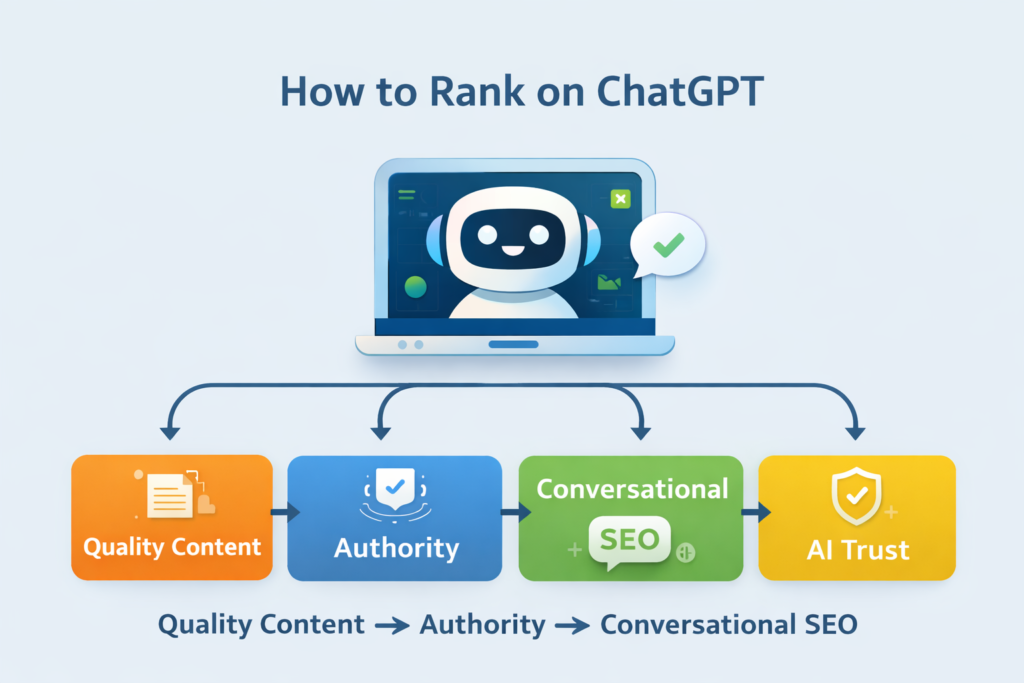
Therefore, your goal is not to rank inside ChatGPT directly. Your goal is to become the kind of source AI trusts.
Create Content That Answers Questions Clearly
ChatGPT prefers content that sounds natural and helpful. Therefore, write as if you are explaining something to a real person.
Use:
- Short sentences
- Simple words
- Clear headings
Moreover, focus on one idea per paragraph. This improves readability and helps AI models understand your content better.
Example:
Instead of writing long, complex sentences, break them into two or three simple ones.
Focus on Conversational Keywords
Traditional SEO targets short keywords. However, ChatGPT favors conversational queries.
For example:
- “How to rank on ChatGPT”
- “Can ChatGPT recommend websites?”
- “How does AI search work?”
Therefore, include natural questions in your headings and content. Also, use “how,” “why,” and “what” frequently. This aligns your blog with how people actually talk to AI.
Build Topical Authority, Not Just Traffic
One blog is not enough. ChatGPT values topic depth.
Therefore:
- Write multiple blogs around AI search, GEO, and conversational SEO
- Interlink related articles
- Cover beginner to advanced topics
Moreover, consistency matters. If your site repeatedly explains a topic well, it builds authority over time.
Optimize for Readability (Very Important)
Easy reading is critical. ChatGPT favors content that is simple and clear.
Follow these rules:
- Keep sentences under 20 words
- Use transition words like therefore, moreover, also, however
- Avoid jargon unless necessary
Also, use bullet points where possible. This improves both human and AI understanding.
Strengthen E-E-A-T Signals
Experience, Expertise, Authority, and Trust matter more than ever.
You can improve this by:
- Adding author bios
- Sharing real examples
- Citing reliable sources
- Updating content regularly
Moreover, personal insights and original analysis help your content stand out from generic blogs.
Get Mentioned on Trusted Platforms
ChatGPT learns from widely referenced content. Therefore, mentions matter.
Try to:
- Publish on Medium or LinkedIn
- Answer questions on Quora
- Get backlinks from authority sites
Also, being discussed on forums and blogs increases your digital footprint.
Use Structured Content Formats
AI understands structured content better.
Therefore, use:
- Clear H1, H2, and H3 headings
- FAQs at the end of blogs
- Step-by-step sections
Moreover, FAQ-style content works extremely well because it mirrors how users ask ChatGPT questions.
Update Old Content Regularly
AI prefers fresh and accurate information. Therefore, revisit older blogs and update them.
You can:
- Add new sections
- Improve clarity
- Include recent examples
Also, updating content signals reliability and relevance.
Conclusion
Ranking on ChatGPT is not about tricks. It is about clarity, trust, and usefulness.
Therefore, focus on helping users first. Write naturally. Explain concepts simply. Build authority over time.
Moreover, as AI search grows, early adopters will benefit the most. If you start optimizing now, you position yourself ahead of the curve.
The future of search is conversational. And your content should be too.

Leave a Reply