Short answer: yes, SEO works for startups—but only when done with the right expectations, strategy, and patience. Long answer? That’s what this article is for.
I’ve worked with multiple early-stage businesses—from bootstrapped founders to funded startups—and I’ve seen SEO succeed, struggle, and sometimes fail. Therefore, this isn’t a theoretical take. It’s based on what actually happens when startups try to grow through search.
Let’s break it down in a simple, honest way.
- What SEO Really Means for Startups? (Not the Textbook Definition)
- A Real Startup Case Where SEO Worked
- When SEO Did NOT Work? (At First)
- How Long Does SEO Take for Startups?
- SEO vs Paid Ads for Startups
- What is the Real SEO Budget Startups Need?
- What are the Biggest SEO Mistakes Startups Make?
- When SEO Is NOT the Right Channel?
- So, Does SEO Work for Startups?
- Final Advice for Startup Founders
- FAQs related to “Does SEO Work for Startups?”
What SEO Really Means for Startups? (Not the Textbook Definition)
For startups, SEO is not about “ranking #1 on Google” or chasing high-volume keywords. Instead, it’s about earning consistent, compounding visibility from people who are already searching for solutions.
Moreover, unlike ads, SEO doesn’t stop working the moment you stop paying. It builds momentum over time—if done correctly.
However, this also means SEO is not instant. And that’s where many startups get disappointed.
A Real Startup Case Where SEO Worked
One early-stage service startup I worked with had:
- Almost zero organic traffic
- No brand recognition
- A very limited marketing budget
Instead of targeting competitive keywords, we focused on:
- Long-tail, problem-driven searches
- Clear service pages optimized for intent
- Simple educational blog content answering real customer questions
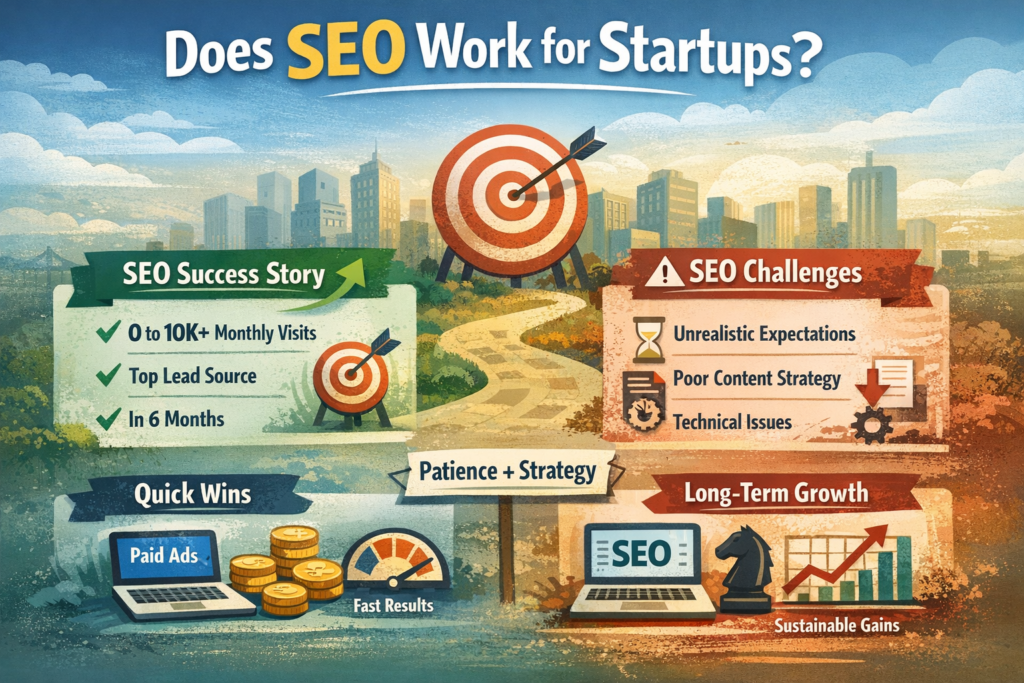
Within 4 months, impressions started rising. By month 7, organic traffic became their top lead source, outperforming paid ads in both cost and quality.
Therefore, SEO didn’t just bring traffic—it brought better leads.
When SEO Did NOT Work? (At First)
On the other hand, I’ve also seen SEO fail—especially when startups:
- Expected results in 30 days
- Published content without a strategy
- Copied competitors instead of focusing on users
In one case, a startup invested in SEO but ignored technical issues and search intent. As a result, traffic grew slowly and conversions stayed flat.
The lesson? SEO without clarity is just content production, not growth.
How Long Does SEO Take for Startups?
This is the most common—and most important—question.
From real experience:
- 0–3 months: Foundations, indexing, early impressions
- 3–6 months: Keyword movement, first consistent traffic
- 6–12 months: Leads, conversions, and ROI
Moreover, early signs of success include:
- Google Search Console impressions increasing
- Pages getting indexed faster
- Long-tail keywords ranking before head terms
If none of these happen, something is wrong.
SEO vs Paid Ads for Startups
Paid ads give speed. SEO gives sustainability.
Also, ads stop the moment your budget stops. SEO, on the other hand, continues to deliver value long after the work is done.
That said, SEO should not always replace ads. In many startups, ads help validate offers quickly, while SEO builds long-term growth.
Therefore, the smartest approach is often SEO + paid, not one versus the other.
What is the Real SEO Budget Startups Need?
SEO doesn’t have to be expensive—but it can’t be free either.
A realistic startup SEO investment includes:
- Time from founders or a team member
- Content creation (even if done in-house)
- Basic technical setup and tracking
Trying to “do SEO without investing anything” usually leads to:
- Inconsistent publishing
- Poor-quality content
- No measurable results
Moreover, SEO rewards focus, not volume.
What are the Biggest SEO Mistakes Startups Make?
After working with multiple startups, these mistakes appear repeatedly:
- Targeting keywords that are too competitive
- Writing content for algorithms, not people
- Ignoring conversion and intent
SEO traffic without conversions is just vanity. Therefore, every page should have a clear purpose.
When SEO Is NOT the Right Channel?
SEO is not always the best choice—especially when:
- You need immediate revenue
- Your product has no existing search demand
- Your market is extremely niche or sales-driven
In these cases, SEO can still help later, but it shouldn’t be the first growth lever.
Honest SEO advice sometimes means saying “not yet.”
So, Does SEO Work for Startups?
Yes—but only when startups treat SEO as a long-term business asset, not a quick hack.
SEO works when you:
- understand your audience’s questions
- commit consistently
- measure progress realistically
Moreover, startups that win with SEO don’t chase algorithms. They solve problems better than competitors.
Final Advice for Startup Founders
If you’re a founder asking, “Should I invest in SEO?”—here’s the real answer:
Start SEO early, but scale it slowly.
Focus on clarity, not volume.
And most importantly, be patient.
Because when SEO works for startups, it doesn’t just bring traffic—it builds trust, authority, and long-term growth.

Leave a Reply