
If you’ve ever asked, “Why isn’t my business showing up on the first page of Google?”—you’re not alone. I’ve spent over a decade helping businesses rank, from local service providers to competitive B2B companies. Some succeeded quickly. Others struggled for months. The difference was never luck. It was strategy, execution, and expectations.
In this post, I’ll explain what actually gets a business to page one of Google today, based on real campaigns, real mistakes as well as real results—not outdated SEO checklists.
Why Ranking on Google’s First Page Matters?
Before doing anything else, you need clarity. Ranking on Google is not about “being everywhere.” It’s about showing up for the right searches.
For example, ranking #1 for a keyword with no buying intent will not grow your business. Therefore, the goal is not traffic alone—it’s qualified visibility.
In my experience, businesses that succeed focus on:
- Keywords tied to clear intent
- Pages built to answer that intent fully
- Long-term authority, not shortcuts
Once you accept this, everything else becomes easier.
Why Most Businesses Fail to Reach Page One?
The biggest mistake I see is this: businesses try to rank for keywords they haven’t earned the right to rank for.
They go after highly competitive keywords too early, broad terms with no intent clarity and also thier content is written for search engines, not users. Moreover, many rely on generic SEO advice like “just write blogs” or “build backlinks,” without understanding why those things work.
Therefore, Google does not reward activity. It rewards relevance, usefulness, and trust.
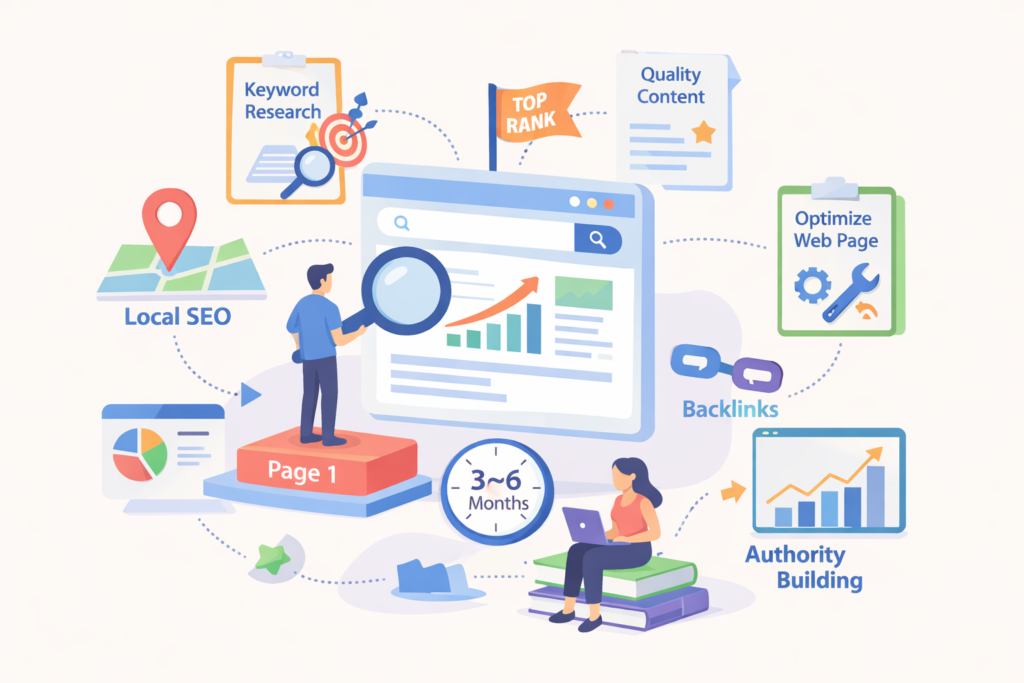
Key Strategies to Rank Your Business on Google’s First Page
Let me share a real pattern I’ve seen across multiple projects.
In one case, a service-based business was stuck beyond page 5 for its main keywords. Instead of chasing more content, we focused on:
- Fixing search intent mismatch
- Rewriting one core service page
- Strengthening internal links
- Supporting it with one highly targeted blog
Within 4 months, that single page moved to page one and also became the main lead driver.
The lesson? One strong page beats ten weak ones.
The Ranking Factors That Matter Most Today
From real-world testing, these factors consistently make the biggest difference:
1. Search Intent Alignment
If your page does not match what users expect, it will not rank—no matter how optimized it is.
2. Content Depth (Not Length)
Google rewards pages that answer the question fully. Therefore, focus on clarity, examples, and completeness—not word count.
3. Internal Linking
Most businesses ignore this. However, strategic internal links help Google understand page importance and context.
4. Authority Signals
This includes backlinks, brand mentions, and also topical depth. Moreover, authority builds over time—it cannot be rushed.
How I Approach Keyword Research Differently?
Most keyword research starts with tools. Mine starts with people.
I ask:
- What problem is the searcher trying to solve?
- Are they researching, comparing, or buying?
- What would actually help them decide?
Only then do I use tools to validate search volume and competition.
As a result, I often choose lower-volume keywords that convert better, because ranking #3 for a high-intent query beats ranking #1 for a vague one.
The Role of Content in Ranking on Page One
Content still matters—but not in the way most blogs explain it.
Today, the pages that rank are highly focused on one topic, written for humans first, structured for easy scanning and also, supported by related content.
Moreover, Google increasingly rewards experience-based content—pages that show you’ve actually done the work, not just written about it.
Therefore, sharing real examples, processes, and lessons learned is no longer optional.
Local SEO vs National SEO: What Changes?
If you’re a local business, proximity and trust matter more. This means:
- Google Business Profile optimization
- Location-specific landing pages
- Reviews and consistency
However, the core principle stays the same: be the best answer for that search.
For national or global SEO, competition is higher, so authority and topical depth become even more critical.
How Long Does It Take to Reach Page One?
This is one of the most common questions I get.
Based on experience:
- Low-competition keywords: 1–3 months
- Medium competition: 3–6 months
- High competition: 6–12+ months
However, timelines depend on your website’s age, existing authority, content quality as well as consistency.
SEO is not instant. But when done right, it compounds.
One Action You Can Take This Week
If you do nothing else, do this: Identify one important page and improve it instead of creating a new one. Specifically rewrite it to better match search intent, add clearer headings and examples, strengthen internal links pointing to it and remove fluff.
This single action has driven more page-one rankings for my clients than publishing dozens of new posts.
Final Thoughts: Page One Is Earned, Not Hacked
Getting your business on the first page of Google is not about tricks. It’s about earning relevance and trust over time.
Therefore, focus on:
- Solving real problems
- Creating fewer, better pages
- Building authority naturally
- Measuring what actually drives leads
If you approach SEO this way, page one becomes a byproduct—not the goal itself.
And that’s how sustainable rankings are built.

Leave a Reply