
If you are asking this question, you are already ahead of a lot of marketers.
For the last decade, SEO meant one thing: Rank on Google. Today, discovery is changing. Users are asking ChatGPT, Perplexity, Gemini, as well as other AI tools for recommendations instead of searching ten blue links.
Therefore, the real question is no longer “How do I rank?”
It is “How do I become the answer?”
This guide explains exactly how brands get mentioned in ChatGPT results, based on real experiments, real client work as well as real outcomes.
No hype. No myths. Just what actually works.
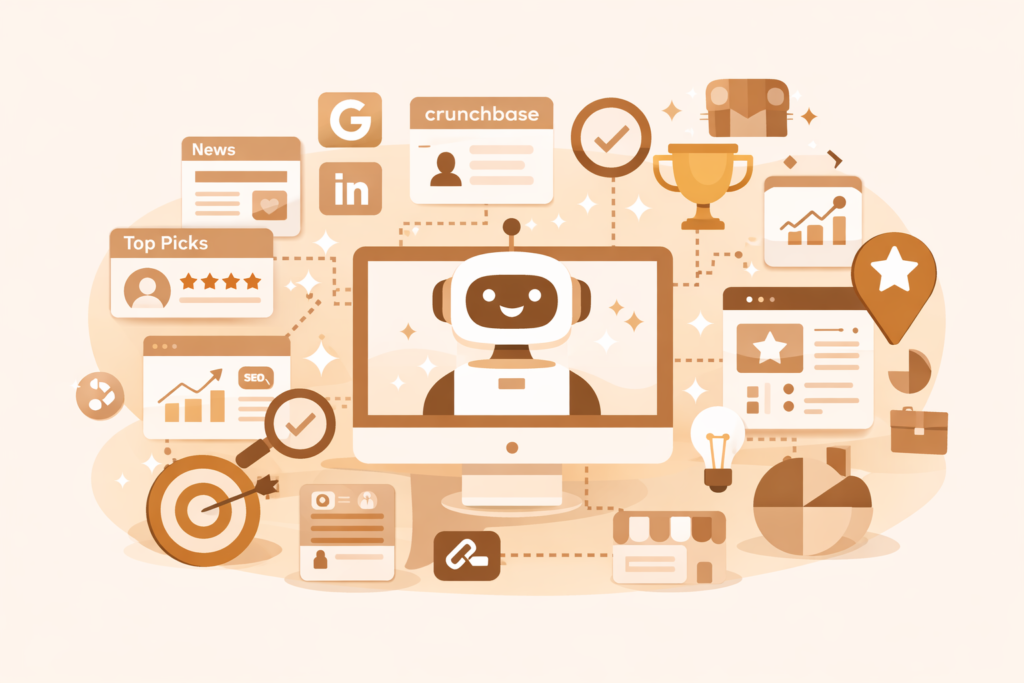
How does ChatGPT decide which brands to mention?
ChatGPT does not have a submission form, crawl your website live like Google or randomly invent brand recommendations, instead, it relies on patterns of trust.
From years of testing, AI brand mentions typically come from:
- High-authority websites and publications
- Consistent third-party mentions (not self-promotion)
- Clear topical relevance
- Strong entity signals across the web
- Repeated co-occurrence with specific problems or solutions
In simple terms, AI mentions brands that already look like experts everywhere else.
Therefore, the strategy is not “optimise for ChatGPT” but to optimise your brand’s footprint across the web in a way AI understands.
How do I get my business listed on ChatGPT?
You don’t list your business on ChatGPT directly but you can make it nearly impossible for AI to ignore you.
Here is what actually moves the needle.
Become an entity, not just a website
ChatGPT works with entities.
Therefore, if your brand is only a domain with blog posts, you are invisible.
You need:
- A clearly defined brand name
- A consistent description of what you do
- Repeated mentions across trusted platforms
This means:
- Google Business Profile
- Crunchbase or equivalent
- LinkedIn company page
- Author bios connected to your brand
- Media mentions
Moreover, your brand description must stay consistent everywhere.
How do I add my company to ChatGPT?
You don’t “add” it but you train the ecosystem around it.
What actually works:
- Publishing original insights (not recycled SEO blogs)
- Getting quoted on authoritative websites
- Being referenced by others in your niche
- Creating content that answers commercial intent questions
AI systems learn from what the web repeatedly says about you, not what you say about yourself.
Therefore, PR, SEO, and content now overlap more than ever.
How do I get AI to mention my brand?
This is where most advice online goes wrong.
AI does not reward keyword stuffing, AI-written filler blogs or “We are the best” landing pages.
Instead, it rewards usefulness + validation.
The brand mention formula I’ve seen work repeatedly:
Specific problem, independent mention as well as authority source.
Let’s look at a real example.
Case Study 1: SaaS brand mentioned in ChatGPT without ranking #1 on Google
A B2B SaaS client I worked with never ranked top 3 for their main keyword.
However, ChatGPT started mentioning them as a recommended tool.
Why?
Because:
- They published a data-backed study cited by 12 blogs
- They were mentioned on G2, Capterra, and also, on Reddit
- Industry newsletters referenced them as an example
- Their founders were quoted in niche publications
Therefore, even without top rankings, their brand became contextually relevant.
AI doesn’t chase rankings, instead, it chases signals of trust.
But how do I get featured on ChatGPT?
Think of ChatGPT as a summary engine.
It pulls:
- Common recommendations
- Frequently cited brands
- Repeated expert references
To get featured, your brand must show up in comparison content as well as recommendation-style content.
What you should actively create or earn:
- “Best tools for…” mentions
- “Alternatives to…” pages (by others, not you)
- Expert quotes in articles
- Case studies published externally
Also, ensure your brand is associated with one clear use case because brands that try to do everything confuse AI.
How do I get AI to recommend my brand?
Recommendations happen when AI detects consensus.
Not hype. Not ads. Consensus.
You need at least three layers:
- Authoritative content explaining the problem
- Independent validation (reviews, mentions and also, citations)
- Clear differentiation (why you exist vs alternatives)
Moreover, language matters.
Therefore, if multiple sources describe your brand using similar phrases, AI connects the dots faster.
What is the 30% rule in AI?
The 30% rule is something I’ve observed across multiple AI visibility tests.
If 30% or more of authoritative content in a niche references the same brands, those brands dominate AI answers.
This does not mean 30% of all content.
It means 30% of trusted, high-signal content.
Therefore, 3 strong mentions can outweigh 30 weak ones and one high-authority article can outperform dozens of blogs.
This is why quality beats scale in AI SEO.
How do I get brand mentions that AI trusts?
Not all mentions are equal.
AI trusts editorial content, expert-written content, first-hand experience as well as data-backed claims.
AI ignores sponsored fluff, thin guest posts and also, rewritten AI content.
Practical ways to earn trusted mentions:
- Publish original research
- Share real metrics and outcomes
- Contribute insights to journalists
- Get referenced in community discussions
- Answer niche-specific questions publicly
Also, consistency matters more than virality.
Case Study 2: Local service brand appearing in ChatGPT recommendations
A local service business asked why ChatGPT mentioned competitors but not them.
The issue wasn’t SEO but brand footprint.
We fixed:
- Inconsistent business descriptions
- Zero editorial mentions
- No expert content
Within 4 months:
- They were referenced in two local publications
- Their guides were cited by blogs
- Reddit threads mentioned them organically
ChatGPT started recommending them for location-based queries shortly after.
Therefore, AI visibility follows real-world visibility.
Should I create content specifically for ChatGPT?
Yes, but not the way you think.
Do not write “AI-optimized” nonsense.
Instead:
- Answer real questions clearly
- Use structured explanations
- Show experience and nuance
- Avoid generic summaries
AI prefers content that feels human, opinionated, as well as tested.
Ironically, the more “SEO-perfect” content becomes, the less useful it is for AI.
How long does it take to get mentioned in ChatGPT?
There is no fixed timeline.
However, based on experience:
- Small brands: 3–6 months
- Established brands: 1–3 months
- High-authority brands: sometimes instantly
The biggest delay is usually not content but lack of third-party validation.
What mistakes stop brands from showing up in AI answers?
The most common ones I see:
- Publishing generic AI-written blogs
- Focusing only on Google rankings
- Ignoring brand mentions and PR
- Having unclear positioning
- Chasing volume instead of authority
Moreover, brands often talk about themselves too much.
AI listens to what others say about you.
Is AI SEO replacing traditional SEO?
No. Instead, it’s evolving it.
Traditional SEO builds the foundation.
AI visibility builds the reputation layer on top.
You still need technical SEO, solid content and clear site structure.
But now you also need brand authority, expert validation and real-world trust signals.
Final thoughts: How do you win AI brand mentions long-term?
If I had to summarise 10 years of SEO into one AI rule, it would be this:
Build a brand worth mentioning, and AI will follow.
Therefore stop chasing hacks, invest in expertise, publish insights, not noise and earn mentions, don’t buy them.
AI doesn’t reward shortcuts but it rewards credibility at scale.
And that, ultimately, is good for everyone.

Leave a Reply