
You open Google Analytics. You expect traffic from your target market. Instead, you see visits from countries you have never sold to. India. Brazil. Vietnam. Poland. Therefore, confusion sets in. Also, doubt creeps in. Is this bad traffic? Is something broken? Or is SEO doing its job in unexpected ways?
This question comes up often. Moreover, it usually shows up once a site starts gaining real visibility. As a result, the answer is rarely simple. However, it is almost always explainable.
Let’s break it down. Clearly. Practically. With real examples.
Is international traffic always a bad sign?
No. In fact, it is often neutral or even positive. Therefore, panic is unnecessary.
Search engines do not think like businesses. Instead, they think like matchmakers. They connect queries to content. Geography is only one signal. Moreover, it is not always the strongest one.
If your content answers a query well, Google may test it globally. As a result, you see impressions and clicks from unexpected locations.
Also, many tools, platforms, and resources are consumed globally. Therefore, even local businesses can attract international interest.
Could search intent be broader than my business location?
Yes. And this is one of the most common reasons.
You may target a local service. However, your content may answer a general problem. Therefore, users from anywhere can find it useful.
For example, a UK-based accounting firm published a blog about VAT registration thresholds. The intent seemed local. However, the article ranked globally for “VAT threshold explained.” As a result, traffic came from over 40 countries.
Moreover, students, researchers, and freelancers often search without buying intent. Therefore, they still click.
This does not mean the traffic is useless. However, it does mean intent analysis matters.
Is my content ranking for informational keywords worldwide?
Very likely.
Informational keywords travel. Therefore, they ignore borders.
If you write guides, how-tos, definitions, or comparisons, Google may rank you internationally. Also, English content especially travels far.
Case study:
A SaaS company selling only in North America published a detailed comparison page. The page explained “CRM vs ERP.” Within three months, 38% of traffic came from Asia and Europe. Why? Because the keyword was informational. Moreover, the content was thorough.
As a result, Google rewarded it globally.
Can backlinks from other countries influence traffic location?
Absolutely. And this is often overlooked.
Links act as distribution signals. Therefore, where links come from matters.
If a popular site in another country links to you, Google may test your content in that region. Moreover, referral traffic may follow directly.
Real example:
An Australian ecommerce site earned a backlink from a German tech blog. The linked page was a buying guide. As a result, Germany became the third-largest traffic source within weeks.
Also, content syndication can amplify this effect.
Is Google testing my site in new markets?
Yes. This happens more than people realize.
Google runs constant experiments. Therefore, it pushes content into new SERPs to measure engagement.
If users click, scroll, and stay, visibility increases. Moreover, geography becomes secondary.
This is especially common when your:
- site has strong topical authority
- content has high dwell time
- pages load fast globally
As a result, you may see temporary spikes from random countries.
Could bots or crawlers be inflating my international traffic?
Sometimes. But not as often as people assume.
Modern analytics filters most bad bots. However, some still slip through. Therefore, checking behavior metrics is important.
Bot traffic usually has:
- 0 second session duration
- 100% bounce rate
- No conversions
If your international traffic behaves like humans, it probably is human. Also, check ISP and network domains for clarity.
Is my website appearing in Google Discover or news surfaces?
If yes, international traffic makes perfect sense.
Discover is interest-based, not location-based. Therefore, content can surface anywhere.
Case study:
A B2B cybersecurity blog published an article about a new ransomware trend. It was picked up by Google Discover. As a result, traffic poured in from over 60 countries in 48 hours.
Moreover, none of those users were buyers. However, brand searches increased later.
Therefore, short-term international traffic can lead to long-term brand lift.
Does language play a bigger role than location?
Yes. Especially for English sites.
English is the default search language in many countries. Therefore, users often search in English even if businesses are local.
This means your content competes globally by default. Also, Google does not restrict English results by country unless intent is local.
As a result, your rankings travel.
Am I accidentally targeting global keywords?
This happens more often than expected.
Keyword tools often hide geographic spread. Therefore, a keyword may look local but isn’t.
For example:
“Website audit checklist” sounds neutral. However, it has global demand. Moreover, competition is international.
If you rank for such terms, global traffic follows naturally.
Can CDN usage or hosting location affect traffic geography?
Indirectly, yes.
Using a CDN improves global load times. Therefore, bounce rates drop for international users. Moreover, Google notices engagement improvements.
This does not cause traffic. However, it enables it.
Also, hosting location no longer limits rankings. That myth is outdated.
Should I block traffic from countries I don’t serve?
Usually, no.
Blocking by IP can:
- Harm crawlability
- Reduce link equity
- Break legitimate user access
Instead, qualify traffic. Therefore, focus on conversions, not visits.
If international users are irrelevant, guide them gently. Also, make your service area clear.
How do I tell if this traffic is hurting my SEO?
Look at outcomes, not volume.
Ask these questions:
- Are rankings dropping? If not, you’re fine.
- Are conversions stable? If yes, no issue.
- Is engagement healthy? If yes, Google approves.
Bad traffic hurts only when it skews signals. Moreover, most international traffic does not.
Can international traffic help SEO indirectly?
Yes. And this is important.
International users can:
- Link to your content
- Share it socially
- Mention your brand
These signals feed authority. Therefore, local rankings can improve.
One local service site gained backlinks from overseas universities. As a result, its local pack rankings improved.
SEO is interconnected. Geography is only one layer.
What should I do if I only want local customers?
Refine intent, not reach.
Practical steps:
- Add clear location modifiers
- Create local landing pages
- Strengthen Google Business Profile
- Use local schema
Also, keep informational content. Therefore, let it attract authority while service pages convert.
This balance works.
Is this a sign that my SEO is working?
In many cases, yes.
Random international traffic usually appears after:
- Indexing improves
- Authority grows
- Content depth increases
Therefore, it is often a milestone, not a mistake.
However, context matters. Always analyze intent, engagement, and business impact.
Final thoughts: Should I worry about traffic from countries I don’t do business in?
No. You should understand it.
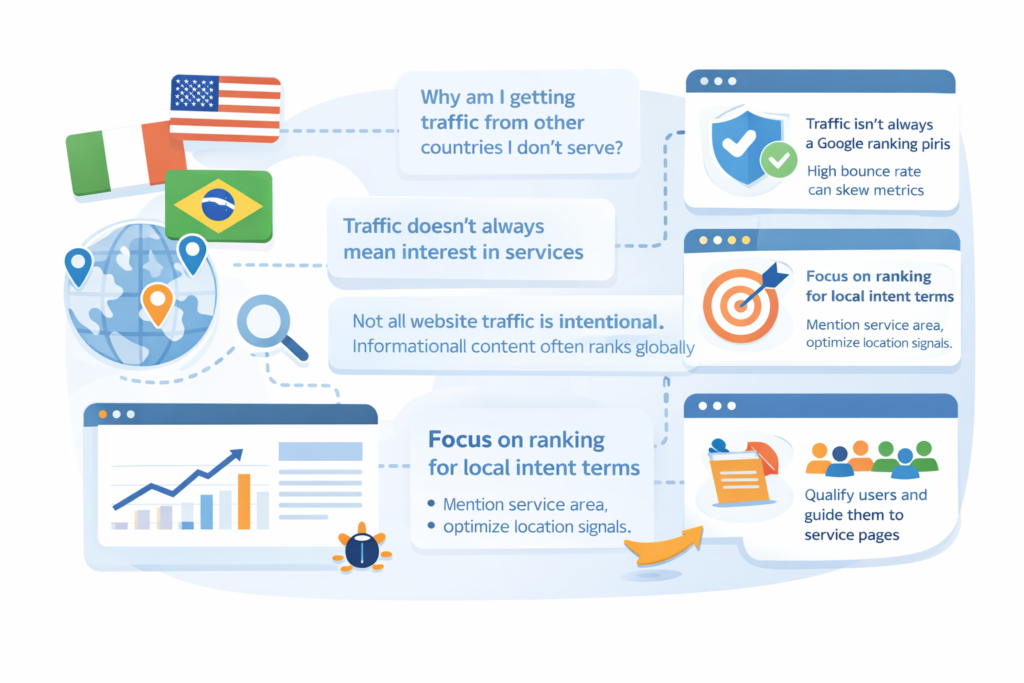
SEO is not a tap you control perfectly. It is a system that responds to usefulness. Therefore, reach expands before revenue does.
If your analytics show global curiosity, it means visibility is growing. Moreover, that is a good problem to have.
Focus on conversions. Refine your pages. Also, let Google explore.
Because when SEO works properly, it rarely stays inside borders.

Leave a Reply