This is one of the most common questions I hear from founders, marketers, and also, in-house SEO teams.
And honestly, it’s a fair one.
SEO starts showing results.
Traffic grows.
Leads come in without paying per click.
So the natural thought is: Why keep paying Google?
However, the real answer is not a simple yes or no.
It depends on timing, data, intent, and risk tolerance.
Moreover, it depends on how you use Google Ads, not just whether you run them.
Let’s break this down properly.
What Does “SEO Starts Working” Actually Mean?
Before stopping anything, we need clarity.
SEO “working” does not mean:
- Ranking for a few low-intent keywords
- Seeing traffic spikes for blog posts
- Getting impressions without conversions
Instead, SEO is working when:
- You rank consistently for commercial and transactional keywords
- Organic traffic converts into leads or sales
- Revenue is predictable month over month
Therefore, if SEO traffic looks good but sales are unstable, you’re not there yet.
Also, rankings alone are a vanity metric but cash flow is not.
Why Do Businesses Want to Stop Google Ads So Quickly?
The main reasons are emotional, not strategic.
For example:
- Ads feel expensive
- SEO feels “free”
- There’s pressure to reduce CAC
- Founders hate seeing daily ad spend
Moreover, Google Ads costs rise over time.
CPC inflation is real.
Competition gets aggressive.
So yes, the instinct makes sense.
However, instinct is not a strategy.
Is SEO Really Free Traffic in the Long Run?
This is a myth that needs to die.
SEO has no per-click cost, true.
But it is not free.
You still pay for:
- Content creation
- Technical SEO
- Link building
- Tools
- Team or agency costs
Also, SEO has a time cost and results come slowly.
Sometimes painfully slowly.
Therefore, comparing Ads vs SEO purely on cost is flawed.
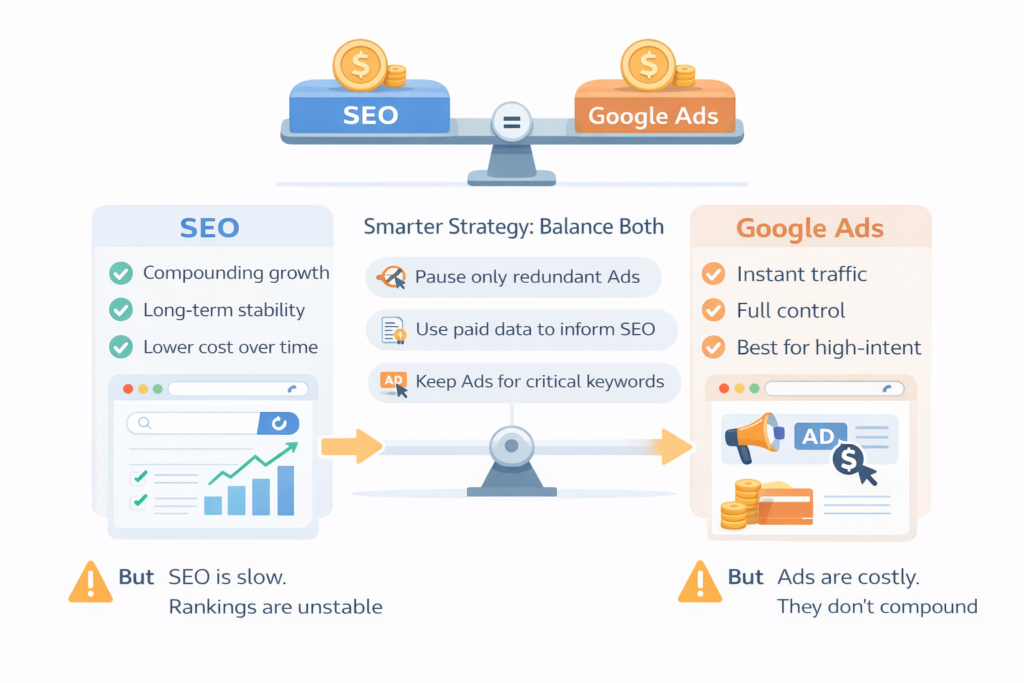
The better comparison is control vs compounding.
What Does Google Ads Do Better Than SEO?
Even after SEO kicks in, Ads still win in key areas.
Speed
SEO takes months.
Ads work today.
Precision
Ads let you target exact keywords, locations, times as well as devices.
SEO cannot do this.
Testing
Ads tell you fast: Which offers convert?, Which headlines work? and also, Which landing pages fail?
SEO takes weeks to validate the same ideas.
Therefore, Ads are not just traffic but a research engine.
What Happens If You Turn Off Google Ads Too Early?
I’ve seen this mistake many times.
And the damage is real.
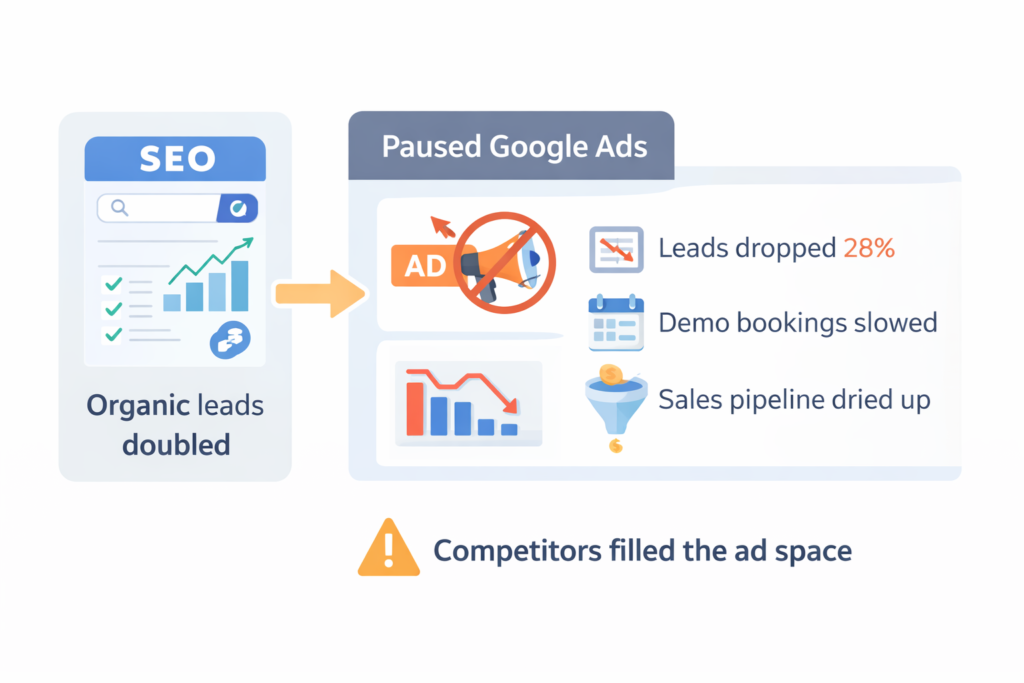
Case Study #1: B2B SaaS (US Market)
A SaaS company ranked top 3 for 15 high-intent keywords.
Organic leads doubled in 6 months.
So they paused Google Ads entirely.
What happened?
- Leads dropped by 28% within 45 days
- Demo bookings slowed
- Sales pipeline dried up
Why?
Because:
- Ads were capturing bottom-of-funnel searches
- Organic results were skipped by users who wanted instant trust
- Competitors filled the ad space immediately
Moreover, brand searches declined because paid visibility disappeared.
They restarted Ads after 3 months.
Recovery took another 2 months.
Lesson: SEO visibility does not replace ad dominance.
Does SEO Reduce Dependency on Google Ads?
Yes.
But it does not eliminate the need.
SEO gives leverage.
Ads give control.
When SEO is strong, you can lower bids, pause low-ROI campaigns and also, focus Ads on high-margin keywords.
Therefore, the goal is optimization, not elimination.
When Does It Make Sense to Reduce Google Ads Spend?
There are moments when pulling back is smart.
Here’s when it works.
1. When Organic Conversions Are Stable
Traffic alone is not enough.
If:
- Organic leads are consistent for 3–6 months
- Conversion rates are predictable
- Revenue doesn’t fluctuate wildly
Then yes, you can reduce spend.
But reduce, not cut.
2. When You Rank #1–#2 for High-Intent Keywords
Position matters.
If you rank:
- #1 organically
- With sitelinks
- With strong CTR
Then Ads may cannibalize clicks.
Therefore, pausing Ads for those specific keywords can make sense.
However, never pause brand Ads blindly.
3. When You’ve Mapped Keyword Intent Properly
Not all keywords behave the same.
SEO works best for:
- Informational queries
- Mid-funnel research terms
Ads dominate:
- Urgent intent
- “Near me”
- Price-based searches
Therefore, smart teams split responsibilities.
SEO educates.
Ads close.
Should You Ever Turn Off Brand Ads?
This is controversial.
And yes, some brands can.
But most shouldn’t.
Case Study #2: Ecommerce Brand (India)
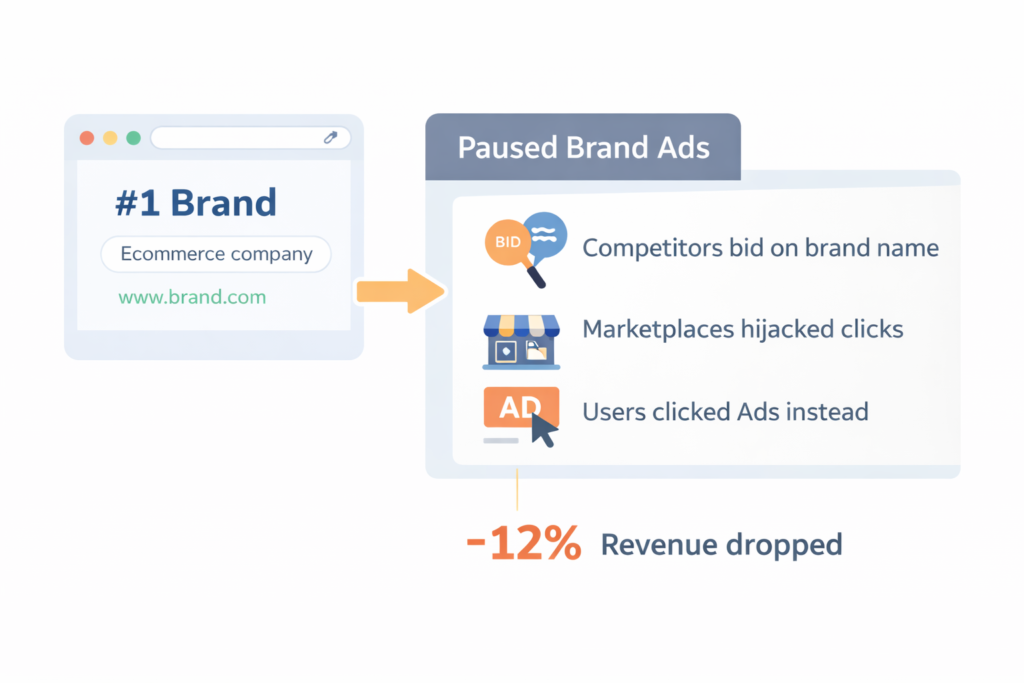
A D2C brand paused brand Ads after ranking #1 organically.
Result:
- Organic clicks increased slightly
- Overall revenue dropped by 12%
Why?
Because:
- Competitors bid on their brand name
- Marketplaces hijacked clicks
- Users clicked Ads instead of scrolling
Therefore, brand Ads acted as defense, not acquisition.
Unless you dominate SERPs completely, brand Ads are insurance.
How Can Google Ads Actually Strengthen SEO?
This is often ignored.
Ads improve SEO indirectly.
Here’s how.
- Ads reveal high-converting keywords
- Those keywords guide content creation
- Landing page data improves UX
- Conversion insights improve organic pages
Moreover, Ads data helps prioritize SEO faster.
Instead of guessing, you act on proof.
What Is the Smartest SEO + Ads Model?
The best teams do this.
- Use Ads aggressively early
- Identify converting keywords
- Build SEO assets around them
- Reduce Ads where SEO dominates
- Scale Ads where SEO cannot win
Therefore, Ads fund SEO learning.
SEO reduces long-term ad dependency.
This is not theory.
It works.
Case Study #3: Local Services Business
A multi-city home services company ran Ads only.
Costs were rising.
Margins were shrinking.
They invested in SEO.
After 9 months:
- Ranked top 3 in 12 cities
- Organic leads covered 65% of demand
They did not stop Ads.
Instead:
- Reduced spend by 40%
- Kept Ads for emergency keywords
- Focused SEO on evergreen services
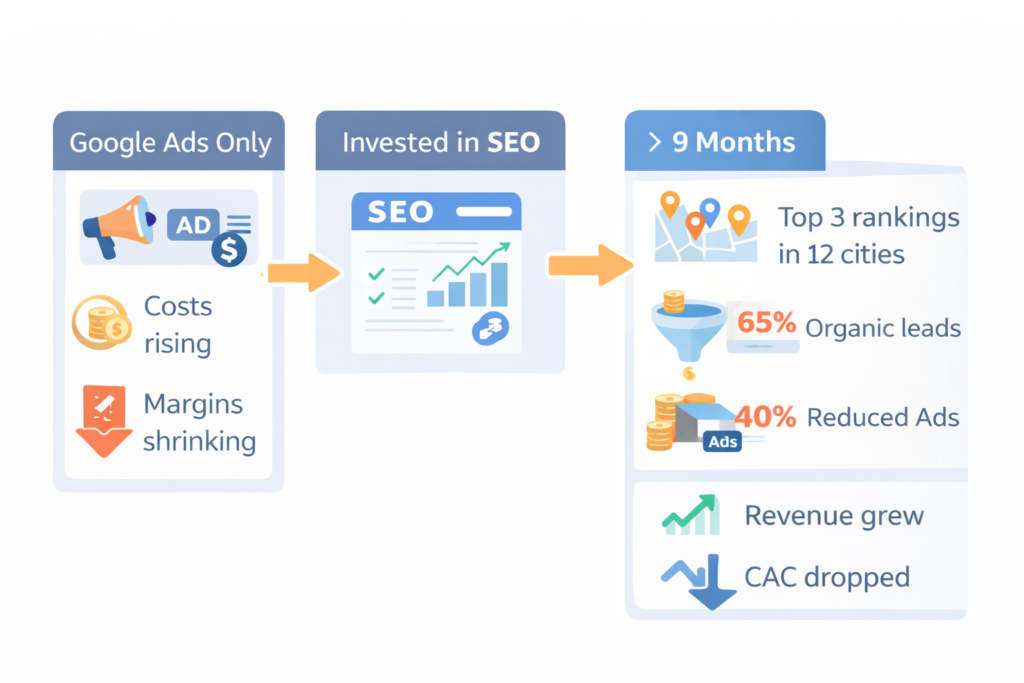
Revenue grew.
CAC dropped.
Risk decreased.
That’s the balance.
What Are the Risks of Relying Only on SEO?
SEO is powerful.
But it’s fragile.
Risks include:
- Algorithm updates
- Competitor link attacks
- SERP layout changes
- AI answers stealing clicks
Moreover, recovery takes time.
Ads, on the other hand, are predictable.
Therefore, removing Ads entirely increases business risk.
Should Startups and Small Businesses Think Differently?
Yes.
Absolutely.
If cash flow is tight:
- Reduce waste
- Kill low-ROI campaigns
- Focus Ads on money keywords
But don’t go dark.
Visibility matters more when you’re small.
SEO will help.
But Ads keep you alive while SEO grows.
How Do You Decide the Right Balance?
Ask these questions: Which channel drives higher LTV? Which keywords convert fastest? Which channel gives control during slow months? What happens if rankings drop tomorrow?
If Ads are your safety net, don’t cut the rope.
So, Should You Stop Running Google Ads Once SEO Starts Working?
No.
You should stop running bad Ads.
You should:
- Pause keywords SEO already dominates
- Lower bids where organic CTR is strong
- Use Ads strategically, not emotionally
Therefore, SEO is not a replacement.
It is a leverage tool.
Ads are not the enemy but blind spending is.
If you want predictable growth, you need both.
Just used wisely.

Leave a Reply