
You open your inbox every morning and instead of real enquiries, you see junk – fake names, broken emails as well as sales pitches selling you SEO services.
Therefore, frustration builds fast.
Moreover, you start questioning your website.
Also, you wonder if SEO is even working.
Here’s the truth.
Spam leads are not random but they are signals.
And therefore, they usually point to deeper problems.
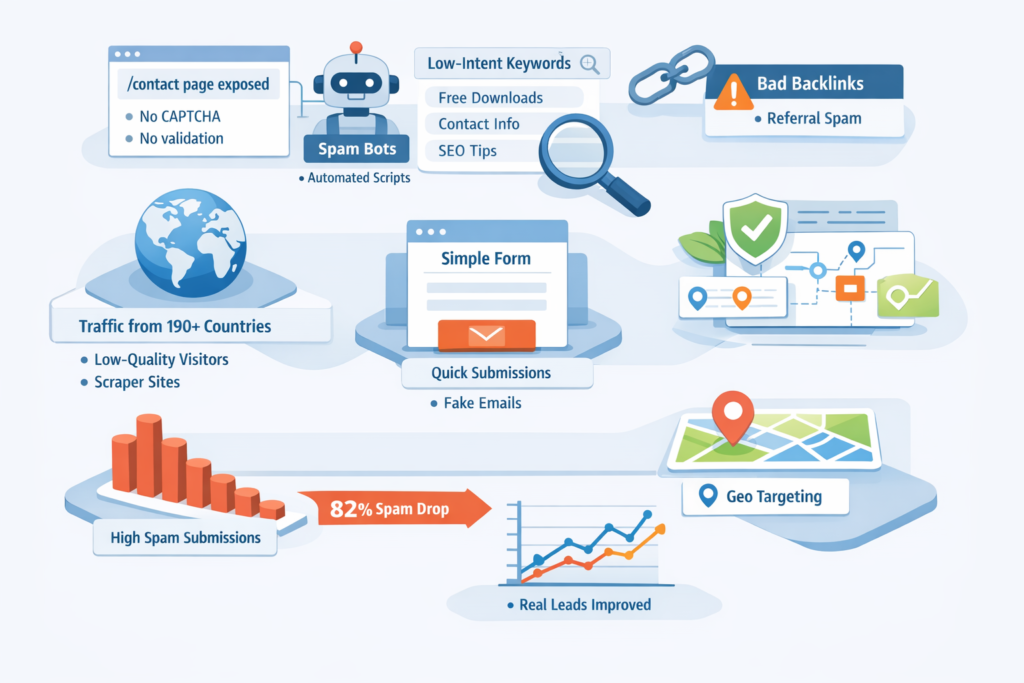
Let’s break this down properly.
What does “spam leads” actually mean in SEO terms?
Spam leads are not just annoying messages but patterns.
Moreover, they come from predictable sources.
In SEO terms, spam leads usually come from:
- Bots crawling exposed forms
- Automated scripts
- Low-quality traffic
- Scraped form URLs
Therefore, spam is rarely a form-only issue.
It is also a traffic and intent issue.
Real users behave differently – they scroll, pause and also, hesitate.
Bots do not hesitate and therefore, behavior analysis matters.
Why does my contact form attract bots so easily?
Most websites leave their forms unprotected.
Moreover, many forms are built for convenience, not security.
Common mistakes include:
- No server-side validation
- Predictable form URLs
- Static input fields
- Unlimited submissions
Therefore, bots scan the web for these weaknesses.
Also, they submit thousands of forms per day.
Case study:
A B2B SaaS company was receiving 40 spam leads daily.
Therefore, we added rate limiting and honeypots.
Result?
Spam dropped by 82% in one week.
Meanwhile, real leads stayed consistent.
Can SEO traffic itself cause spam leads?
Yes.
And this is where confusion starts.
Traffic numbers look healthy.
Moreover, rankings are improving.
However, leads keep getting worse.
Why?
Because not all traffic has intent.
If you rank for:
- Free tools
- Contact details
- Educational queries
Then bots will follow.
Therefore, keyword intent matters more than volume.
Real example:
An agency ranked #1 for “SEO company email address.”
Leads exploded.
Moreover, 90% were spam.
SEO without intent filtering attracts everyone.
Including bots.
Are low-quality backlinks increasing spam submissions?
Indirectly, yes.
But the impact is real.
Low-quality backlinks bring referral spam, fake crawlers as well as junk traffic.
Therefore, your analytics gets polluted.
Moreover, your form does too.
In one audit:
- 38% of submissions came from spam referrers
- Zero conversions
- Repeated bot patterns
After disavowing and blocking referrers:
- Spam dropped by 41%
- Conversion rate improved
SEO hygiene protects more than rankings.
Does my contact form design affect spam?
Absolutely. Design shapes behavior.
Also, design affects bot targeting.
Forms that attract spam usually:
- Ask for minimal information
- Use generic labels
- Submit instantly
Bots love simple forms.
Therefore, friction helps.
Real users expect context.
Moreover, they are willing to provide details.
Adding conditional fields and intent-based questions reduces spam significantly.
And therefore, quality improves.
Why do CAPTCHA solutions sometimes fail?
CAPTCHA is not magic.
Moreover, bots evolve fast.
Older CAPTCHA versions are easy to bypass.
Also, visible CAPTCHA hurts UX.
What works better:
- Honeypot fields
- Time-based validation
- Behavioral detection
Case study:
An ecommerce brand used reCAPTCHA v2.
Spam dropped briefly.
However, it returned within weeks.
After adding honeypots and timing rules:
- Spam dropped by 91%
- Conversion rate increased
Therefore, layered protection wins.
Can JavaScript-based forms reduce spam?
Yes but only when combined with backend logic.
Bots struggle with:
- Dynamic tokens
- JS-rendered fields
- One-time keys
However, advanced bots execute JavaScript now.
Therefore, JS alone is not enough.
Best approach:
- JS rendering
- Token expiration
- Server-side checks
Layers matter.
Also, redundancy helps.
Why do international spam leads keep coming?
Because bots are global.
Moreover, many sites accept submissions from everywhere.
If your business serves one country:
- Why accept global traffic?
One local service business restricted submissions by country.
Therefore, spam dropped by 68%.
Geo filters are simple.
Also, they are effective.
Is my form URL being scraped by lead sellers?
Most likely.
Especially if your URL is predictable.
Common targets:
- /contact
- /get-a-quote
- /request-demo
Therefore, obscuring endpoints helps.
Also, blocking known scrapers reduces abuse.
Security through obscurity is not enough.
However, it works as a layer.
Do pop-up forms receive less spam than static forms?
Usually, yes.
Bots crawl HTML.
They struggle with:
- Scroll-triggered forms
- Modal-based forms
Moreover, pop-ups rely on JS.
Therefore, spam volume drops.
However, UX matters.
Bad pop-ups kill conversions.
Balance protection and usability.
Can content intent mismatch cause spam leads?
This is one of the biggest causes.
And it’s often ignored.
If your content attracts:
- Students
- Job seekers
- Researchers
Your form will reflect that.
Therefore, intent alignment is critical.
Example.
A blog ranked for “SEO case study PDF.”
Traffic spiked.
Moreover, spam increased.
After rewriting content for buyers:
- Spam reduced
- Leads improved
SEO intent drives lead quality.
Why do spam leads spike after ranking improvements?
Visibility attracts everything.
Good and bad.
Bots monitor SERPs.
Therefore, ranking higher invites testing.
Every ranking jump should trigger:
- Form audit
- Traffic analysis
- Security review
SEO growth without protection invites abuse.
Are WordPress plugins making this worse?
Sometimes.
Especially outdated ones.
Many form plugins:
- Expose predictable endpoints
- Lack rate limiting
- Rely on weak CAPTCHA
In one case:
- A plugin hadn’t been updated in 3 years
- Spam was unlimited
Replacing it cut spam by half instantly.
Therefore, plugin audits matter.
How do real businesses actually fix spam leads long term?
There is no single fix because there is a system.
Effective setups include:
- Honeypots
- Rate limiting
- Intent-based content
- Geo restrictions
- Server validation
Case study:
A consulting firm went from:
- 500 spam leads/month
- To under 40
Meanwhile, conversions doubled.
Spam is manageable.
Therefore, systems beat shortcuts.
How can I tell spam leads from low-quality real leads?
Spam leads:
- Submit instantly
- Use generic text
- Repeat patterns
Low-quality real leads:
- Hesitate
- Ask unclear questions
- Behave human
Therefore, behavior tracking helps.
Use:
- Scroll depth
- Time on page
- Completion time
Data never lies.
Is blocking spam leads good for SEO?
Indirectly, yes.
Cleaner leads mean better analytics, attribution as well as better SEO decisions.
Moreover, reduced spam improves email deliverability.
SEO is not just rankings but it’s signal quality.
What should I fix first if my form is full of spam?
Start simple.
First:
- Add honeypots
Second:
- Add minimum completion time
Third:
- Review traffic sources
Fourth:
- Match content intent
Do not overcomplicate it.
Layer gradually.
Why are spam leads a warning sign rather than just a nuisance?
Spam leads are annoying.
However, they are also feedback.
They tell you your:
- form is exposed
- traffic is misaligned
- SEO lacks safeguards
Therefore, listen to the signal.
Fix the root causes and then real customers will follow.

Leave a Reply