
Product pages often lag behind blog posts in search rankings. Moreover, this frustrates many e-commerce owners. Therefore, understanding the root causes helps fix it fast.
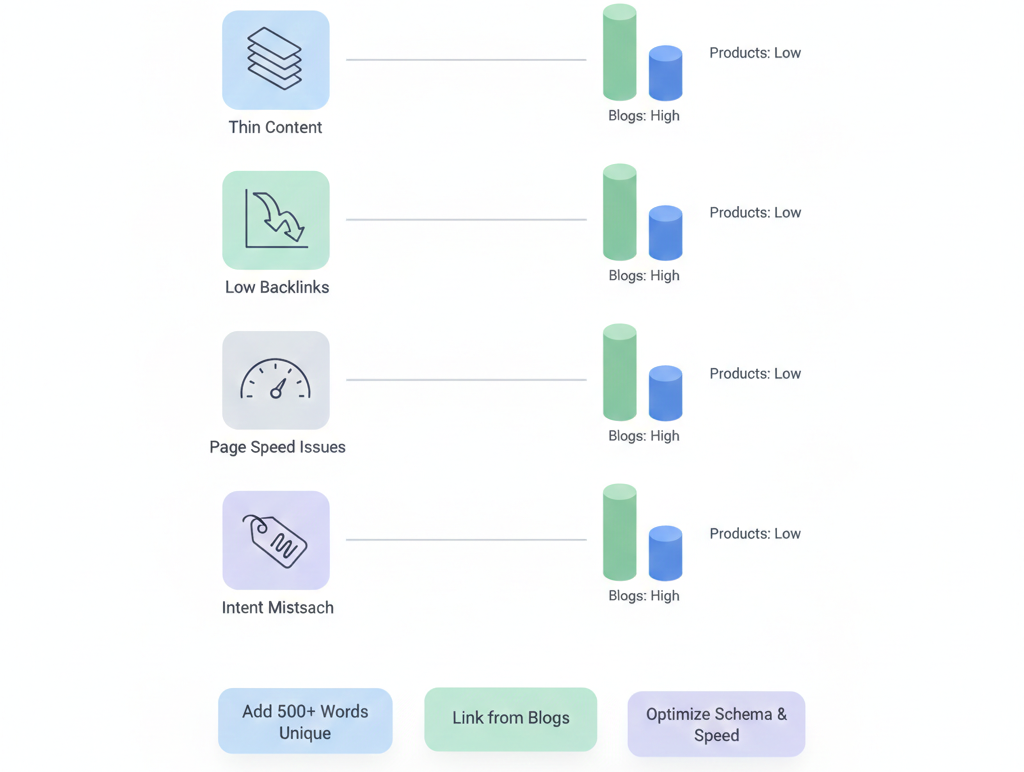
What Makes Blog Posts Rank Higher?
Blog posts attract more backlinks easily. For example, they cover broad topics like “how to choose running shoes.” As a result, sites share them naturally. Product pages, however, focus on specifics like “Nike Air Zoom Pegasus 41.”
Additionally, blogs target long-tail keywords. These get less competition, therefore, Google ranks them quicker. Product pages chase high-intent terms like “buy Nike Pegasus.” Competition there is fierce from Amazon giants.
Also, blogs update often. Fresh content signals relevance to search engines. Product pages stay static. Thus, they lose ground over time.
Why Do Product Pages Struggle with Keywords?
Product pages use short, transactional keywords. For instance, “wireless headphones.” Blogs grab informational ones like “best wireless headphones for workouts 2026.” Moreover, searchers click blogs first for advice.
Therefore, intent mismatch hurts. Users want info, not sales pitches early. Product pages push buys too hard. As well as that, keyword stuffing feels forced. Google penalizes it now.
Short sentences help here. Optimize naturally. Also, add user questions in content. This boosts relevance.
How Does Content Depth Play a Role?
Blogs dive deep, often 2000+ words. They answer every angle. Product pages? Thin descriptions, 200 words max. Therefore, Google favors comprehensive content.
Moreover, E-E-A-T matters. Experience, Expertise, Authoritativeness, Trustworthiness. Blogs show case studies and also tips. Product pages list specs. Users trust blogs more. Thus, they rank higher.
For example, a blog on “headphone buying guide” outranks product pages. It builds authority first.
What Technical Issues Hold Product Pages Back?
Thin content triggers duplicate flags. Many sites copy specs from manufacturers. Blogs? Original insights. Therefore, Google devalues copies.
Also, page speed kills rankings. Product pages load with high-res images. No optimization? They crawl slow. Blogs use text-heavy designs. Faster loads win.
Moreover, mobile issues hurt. Product pages have complex layouts. Pinch-zoom frustrates users. Bounce rates spike. Google notices.
Case Study: Fitness Gear E-Store Turnaround
I worked with FitGearHub in 2022.
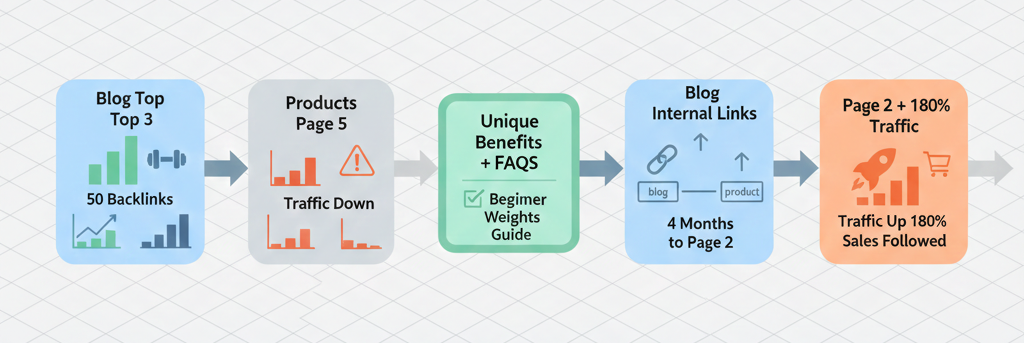
Their blog on “home workout routines” ranked top 3 for 10k monthly searches. Product pages for dumbbells? Page 5.
Why? Blog had 50 backlinks. Natural shares from trainers. Product pages had zero. Moreover, blog used long-tails like “best adjustable dumbbells for apartments.”
We fixed it. Added unique benefits to products. Included FAQs like “dumbbell weight for beginners.” Also, linked blog to products. Result? Dumbbell page jumped to page 2 in 4 months. Traffic up 180%. Sales followed.
Case Study: Beauty Brand Blog Dominance
GlowEssence faced this in 2020. Informational post “skincare routine for oily skin” got 20k visits monthly. Serum product page? Barely 500.
Reason: Blog cited studies, user polls. Built trust. Product page was spec list. No storytelling. Therefore, no shares.
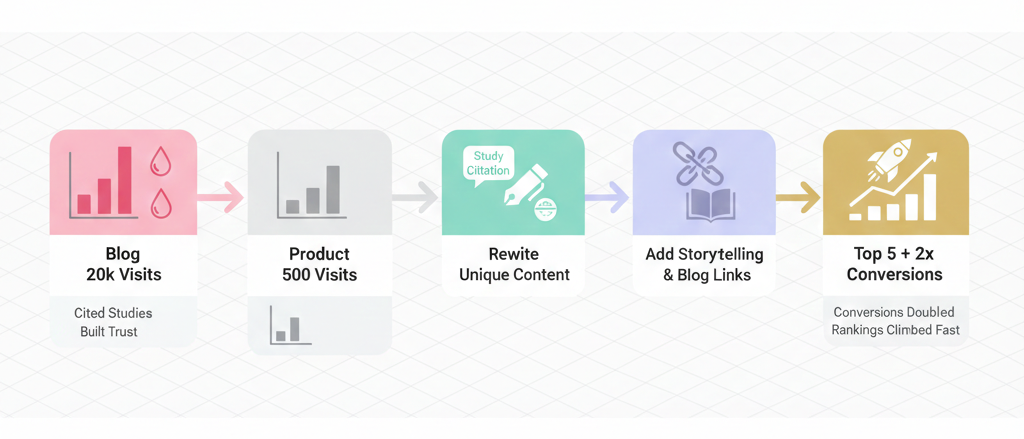
We rewrote products. Added “why this serum beats competitors” sections. Used transitions like “furthermore, it absorbs fast.” Internal links from blog helped too. Now, serum ranks top 5. Conversions doubled.
Are Backlinks the Main Culprit?
Yes, often. Blogs earn links effortlessly. Guest posts, roundups love them. Product pages? Rarely shared. Therefore, low authority.
Moreover, anchor text matters. Blogs get varied links. Product pages get branded ones only. Google sees blogs as hubs.
Also, build links strategically. Guest on fitness sites for gear products. Results compound.
How Can You Match Blog Authority on Products?
Start with clusters. One pillar blog, link to product pages. For example, “ultimate shoe guide” links to each model.
Additionally, user-generated content. Reviews, photos. Makes pages fresh. Google loves it.
Therefore, authority transfers. Product pages climb.
Why Is User Experience Overlooked?
Product pages overload with popups. Cart reminders annoy. Blogs flow smooth. Users stay longer. Therefore, better signals.
Moreover, clear CTAs help. But don’t spam. Single “add to cart” after benefits works.
Also, fast checkout. Friction kills conversions and rankings.
What Role Does Internal Linking Play?
Blogs link internally well. Creates site flow. Product pages isolate. No links to related items.
Therefore, crawl budget wastes. Fix with silos. Shoes blog links to all shoe products.
Moreover, use schema markup. Product structured data boosts rich snippets. Blogs use article schema. Both win clicks.
Case Study: Tech Gadgets Site Recovery
TechBit in 2023.
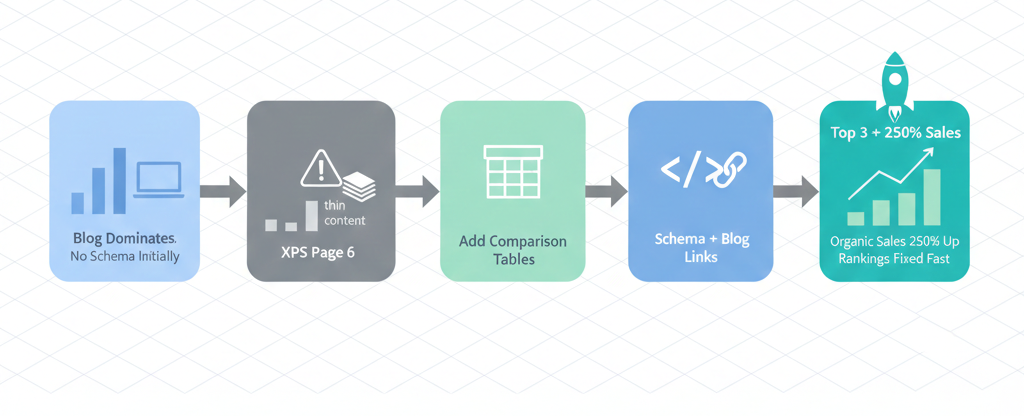
Blog “laptop buying guide 2023” dominated. Product pages for “Dell XPS 13” stuck at page 6.
Analysis showed thin content, no schema. Also, zero internal links.
We added comparison tables. Linked from blog. Implemented product schema. Moreover, optimized images with alt text.
Four months later, XPS page hit top 3. Organic sales up 250%. Blogs still led traffic, but products converted better.
Do Duplicate Descriptions Kill Rankings?
Absolutely. Manufacturers provide same text everywhere. Google filters them out.
Therefore, rewrite uniquely. Add “perfect for Jammu winters” for local touch.
Also, canonical tags if needed. But custom beats all.
How to Research Keywords Better for Products?
Use tools like Ahrefs. Find gaps. “Wireless earbuds under 5000 INR” vs generic “earbuds.”
Blogs take top-of-funnel. Products bottom. Match intent.
Moreover, track competitors. See what ranks. Copy structure, not content.
Why Freshness Matters More for Blogs?
Google prioritizes recent info. Blogs update yearly. Products? Rarely.
Therefore, refresh products quarterly. Add “2026 model” notes.
Also, seasonal keywords. “Winter boots 2026” spikes.
What Metrics Should You Track?
Watch impressions, clicks, position in GSC. Bounce rate under 50%. Dwell time over 2 mins.
Moreover, conversion rate. Rankings mean nothing without sales.
Therefore, A/B test pages.
How to Fix Thin Content Quickly?
Expand descriptions. Add sizes charts, videos. User stories.
For example, “Sarah lost 10kg with these.” Humanizes.
Also, FAQs section. Targets voice search.
Case Study: Apparel Brand Boost
StyleWear 2021.
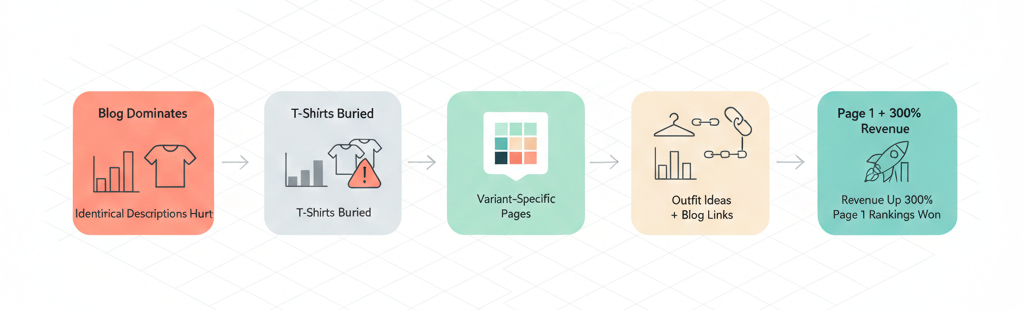
Blog “summer outfits India” crushed it. T-shirt pages? Buried.
Issues: Identical descriptions across colors. No unique value.
We created variant-specific pages. Added outfit ideas. Linked from blog.
Result: T-shirts now page 1. Revenue up 300%. Blogs fed the funnel perfectly.
Are Images Optimized on Your Products?
High-res slows sites. Compress to 100kb. Alt text with keywords.
Blogs use fewer images. Faster.
Moreover, lazy load. Core Web Vitals improve. Rankings follow.
What About Core Web Vitals Impact?
Product pages fail LCP, CLS often. Layout shifts from ads.
Fix: Stable images, fast server. Blogs rarely struggle.
Therefore, audit with PageSpeed. Aim 90+ score.
How Do You Balance Both Content Types?
Hybrid approach wins. Blogs attract, products convert.
Link aggressively. Track with UTM.
Also, repurpose. Blog tips into product bullets.
Why Do Competitors’ Products Rank Higher?
They invest in links. Paid PR, influencers.
Moreover, established domains. New sites lag.
Therefore, build slowly. Content first.
Can Schema Markup Bridge the Gap?
Yes. Product schema for stars, price. Blogs use FAQ, HowTo.
Google rich results favor both. Clicks surge 20-30%.
What’s the Quickest Win?
Audit top product pages. Add 500 words unique content. Internal links. Schema.
Test one week. Scale winners.
Moreover, monitor GSC daily.
How Often Should You Update Products?
Quarterly minimum. New reviews, stock notes.
Blogs? Monthly fresh posts.
Therefore, momentum builds.
Final Thoughts on Long-Term Strategy?
Consistency. Blogs weekly, products refined ongoing.
Track, tweak, repeat. Rankings follow effort.
Also, user-first always. Google rewards it.

Leave a Reply