The digital marketing landscape just shifted. On January 16, 2026, OpenAI officially broke its long-standing “subscription-only” silence by announcing the rollout of advertising within ChatGPT . In this blog you will get complete info about Chatgpt Ads.
For years, the industry speculated how OpenAI would sustain the astronomical costs of compute—reportedly facing an $8 billion loss in 2025—while maintaining a free tier for millions. The answer has arrived: a hybrid model of low-cost subscriptions and a contextually aware ad ecosystem.
This isn’t just “Google Ads in a chatbot.” It is the birth of Conversational Commerce.
1. The Big Announcement: ChatGPT’s Ad Evolution
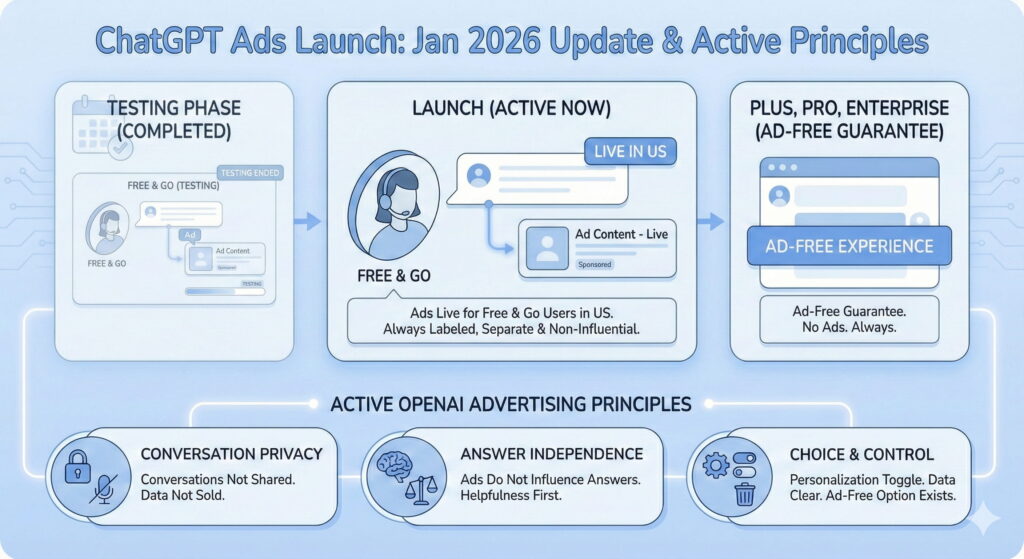
OpenAI has launched a new subscription tier, ChatGPT Go, priced at $8/month. This tier sits between the Free version and the $20/month Plus plan. While Go offers 10x more message limits than the free tier and access to GPT-5.2 Instant, it—along with the Free tier—will soon serve as the primary testing ground for ads in the United States.
Who will see ads?
- Free Users: Regular users who do not pay for a subscription.
- Go Users: Subscribers on the new $8/month budget tier.
Who is exempt?
OpenAI has committed to keeping the premium experience ad-free for high-value tiers:
- Plus ($20/month)
- Pro ($200/month)
- Business & Enterprise
- Education (Edu) accounts
The testing phase is currently rolling out to US-based adults, with a global expansion expected as the platform matures.
2. Anatomy of a ChatGPT Ad: How They Look and Feel
Unlike the cluttered sidebars of legacy search engines, ChatGPT ads are designed to be “native” to the conversation.
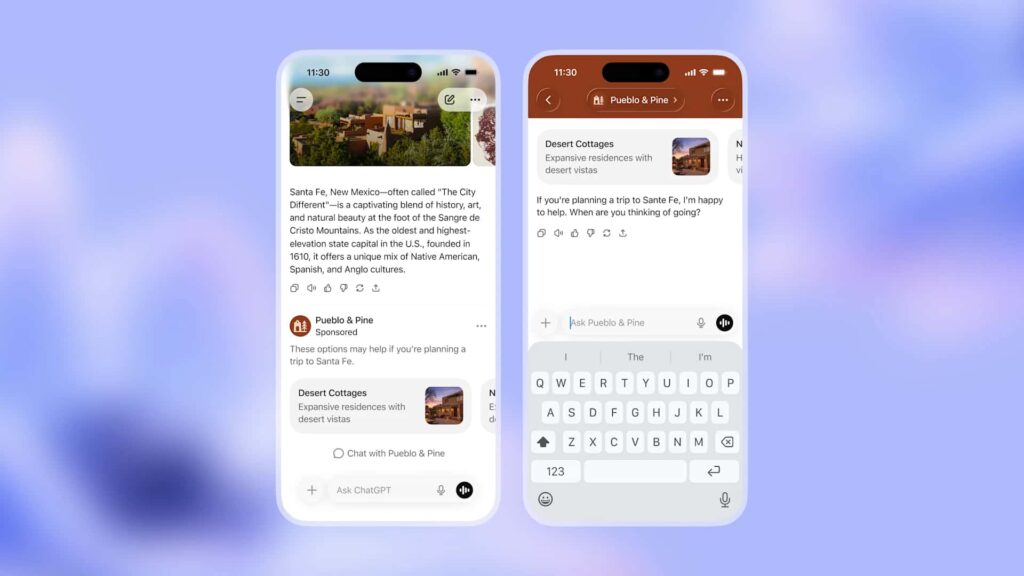
Current Format: The Sponsored Response
Ads appear at the bottom of an AI response. For example, if you ask, “What are the most durable hiking boots for the Pacific Northwest?”, ChatGPT will provide its objective, AI-generated list. Directly below that list, a clearly labeled “Sponsored” section will appear featuring a carousel of relevant products from brands like REI or Salomon.
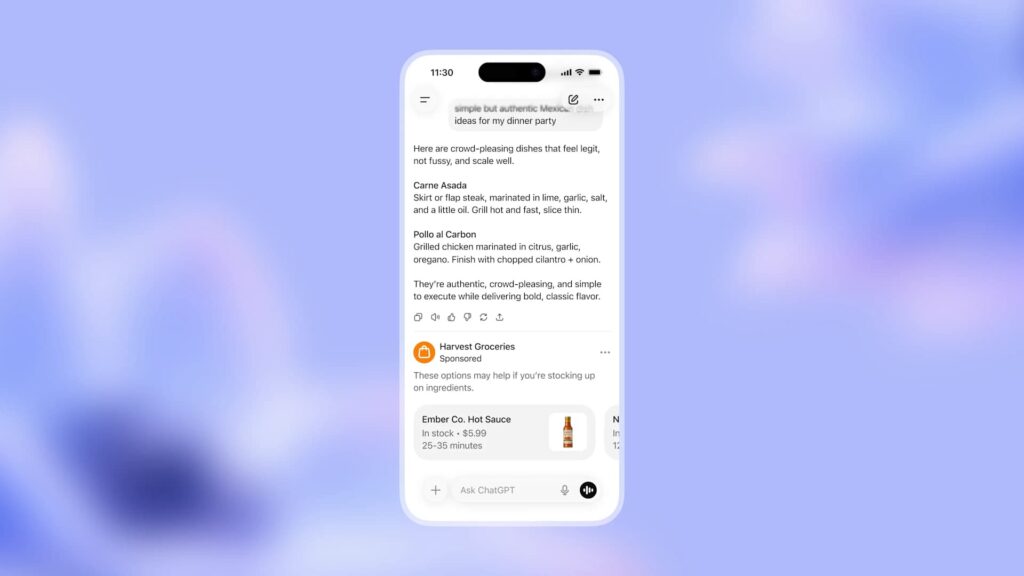
The Future: The Conversational Ad Funnel
The most transformative feature currently in testing is the Direct Message Ad. Soon, you won’t just click a link; you will be able to ask the ad a question.
- Scenario: You see an ad for a CRM software.
- Action: You ask the ad, “Does this integrate with my existing Shopify store?”
- Outcome: The ad itself (powered by the brand’s own API or fine-tuned model) answers you instantly, moving you from “discovery” to “decision” without leaving the chat.
3. OpenAI’s Advertising Principles: Trust as a Currency
Sam Altman has famously expressed a “personal aversion” to traditional advertising. To reconcile this with the need for revenue, OpenAI has established five strict principles:
- Answer Independence: The AI’s “organic” answer is generated first. Advertisers cannot pay to be the “top answer” in the way they can pay for the top spot on Google.
- Conversation Privacy: Your chats are not shared with advertisers. If you see an ad for a lawnmower, the mower company doesn’t know why you saw it—they only know an ad was served.
- No Data Selling: OpenAI maintains they will not sell user profiles to third parties.
- Choice and Control: Users can turn off personalization and clear their ad-targeting data at any time.
- Sensitive Topic Guardrails: Ads will not appear near sensitive topics such as health, mental health, or politics.

4. Why Now? The $1.4 Trillion Pressure
The timing isn’t accidental. OpenAI is reportedly preparing for an IPO in late 2026 or early 2027, seeking a valuation near $1 trillion. To justify that number, they must prove that ChatGPT can generate massive, scalable revenue beyond just $20/month subscriptions.
With over 800 million monthly active users, even a modest CPM (Cost Per Mille) could turn the platform into a multi-billion dollar advertising juggernaut, rivaling Meta and Google.
5. How to Run Ads on ChatGPT?
As of today, there is no “OpenAI Ads Manager” where you can enter a credit card and start bidding. However, the infrastructure is being built. To “run ads” in 2026, you must approach it through a three-stage strategy.
Step 1: Generative Engine Optimization (GEO)
Before the paid platform opens to all, your brand must be “AI-ready.” This is the new SEO.
- Fact-Density: AI models prefer content with high information gain. Instead of “We have the best coffee,” use “Our beans are sourced from the Sidama region of Ethiopia, roasted at 200°C, and contain 15% more antioxidants than standard Arabica.”
- Semantic Footprint: Ensure your brand is mentioned in authoritative guides, Reddit forums, and comparison sites. ChatGPT uses these “citations” to determine relevance.
- OAI-SearchBot Access: Check your
robots.txtfile. Ensure you are not blockingOAI-SearchBot. If the bot can’t crawl you, the ad platform can’t sync your product data.
Step 2: The “Conversational” Creative
Traditional ad copy (Hurry! 50% off!) will fail in ChatGPT. Users are in a “learning” mindset, not a “scrolling” mindset.
- Focus on Utility: Create ad content that solves the user’s current problem.
- Structured Data: Implement
Schema.orgmarkup for your products. This allows ChatGPT to pull price, availability, and reviews directly into the sponsored carousel.
Step 3: Integrating with Bing Webmaster Tools
Since ChatGPT’s real-time search capabilities are heavily subsidized by Microsoft Bing, your presence on the Bing Index is your ticket to the ChatGPT ad auction.
- Submit your sitemap to Bing Webmaster Tools.
- Use the IndexNow protocol to ensure that as soon as you change a price or launch a product, ChatGPT “knows” about it.
6. Which Industries Benefit the Most?
The early winners in ChatGPT advertising will be those with High-Intent, Direct-Solution offerings:
| Industry | Why it Works |
| Local Services | “Emergency plumber near me” triggers an immediate, relevant sponsored card. |
| Niche E-commerce | “Eco-friendly yoga mats for hot yoga” allows for hyper-specific product placement. |
| SaaS & B2B | Users often ask ChatGPT to compare software. Ads allow your brand to be the “Suggested Alternative.” |
| Travel & Planning | “Plan a 3-day trip to Tokyo” is the perfect moment for hotel and tour sponsorship. |
7. Preparing Your Agency for the Shift
If you run a marketing agency, “SEO Specialist” is no longer enough. You need to hire or train for:
- AI Conversation Strategists: People who understand how to map user prompts to brand solutions.
- Conversational Funnel Architects: Designing the logic for when a user asks an ad a follow-up question.
- GEO Specialists: Mastering the art of getting cited by LLMs.
8. Conclusion: The End of the “Pure” AI Era
The introduction of ads in ChatGPT marks the end of the “pure” AI era and the beginning of the AI-Powered Economy. While some users may be frustrated by the appearance of sponsored content, the tradeoff is a more powerful, more accessible, and more sustainable tool for the global population.
For brands, the message is clear: The “Wait and See” period is over. Whether you are a solo founder or a global enterprise, your visibility in the next five years will be determined by how well you converse with the engines that are now answering the world’s questions.

Leave a Reply