A sudden traffic drop can ruin months of work. Rankings disappear. Leads slow down. Revenue dips. Naturally, panic sets in.
However, not every drop means a penalty. Sometimes it’s an algorithm update. Sometimes it’s technical. And sometimes it’s self-inflicted.
So how do you know if Google has manually penalized your website?
Let’s break it down step by step.
What is a manual action in Google’s terms?
A manual action happens when a human reviewer at Google checks your website and decides it violates Google’s spam policies.
This is different from an algorithmic update. Algorithmic hits are automated. Manual actions are applied by a real person.
Moreover, manual penalties are clearly communicated inside Google Search Console. Google doesn’t hide them.
If you have a manual action, then Google will tell you.
However, the real problem is that many site owners don’t check Search Console regularly. Therefore, they assume something else caused the traffic crash.
What is the first place I should check?
Google Search Console.
Go to:
Security & Manual Actions → Manual Actions
If your site has a manual action, you’ll see a message explaining:
- The issue
- The type of violation
- Whether it affects part of your site or the whole domain
If it says “No issues detected,” then you do not have a manual penalty.
However, that does not mean you are safe from algorithmic suppression.
What does a manual action message look like?
Google usually phrases it clearly. For example:
- “Unnatural links to your site”
- “Thin content with little or no added value”
- “Pure spam”
- “User-generated spam”
- “Cloaking and/or sneaky redirects”
- “Spammy structured markup”
Moreover, the message will tell you whether the penalty is:
- Partial match (only certain pages affected), or
- Site-wide match (entire site affected)
Site-wide manual actions hurt much more, therefore, rankings often collapse completely.
How is a manual penalty different from an algorithm update?
This is where many people get confused.
If traffic drops overnight, they then assume manual penalty. However, that’s rarely the case.
Here’s how to tell the difference:
| Manual Action | Algorithm Update |
|---|---|
| You get notified in Search Console | No notification |
| Applied by human reviewer | Applied automatically |
| Requires reconsideration request | Recovery happens after improvements |
| Often sudden and severe | Can be gradual or update-based |
Moreover, algorithm updates often align with public Google update dates. Therefore, always compare your drop with known update timelines.
If your traffic dropped exactly when a core update rolled out, it’s likely algorithmic.
What are the most common manual penalties?
Over the last decade, I’ve seen the same mistakes repeated.
Here are the most common manual actions:
1. Unnatural backlinks
This is the most common one.
Buying links. Link exchanges. Private blog networks. Spammy guest posts.
Moreover, excessive anchor text manipulation is a red flag.
Case Study:
In 2022, an e-commerce site came to me after losing 70% of traffic. Search Console showed a “Unnatural links to your site” penalty.
They had hired a cheap SEO agency. The agency built 1,200 exact-match anchor links in three months.
Therefore, Google flagged the domain.
We audited backlinks, disavowed 800 toxic domains, removed what we could manually and also submitted reconsideration.
Recovery took 5 months.
However, rankings never returned to previous levels fully.
2. Thin or auto-generated content
AI-generated content without value. Scraped content. Spun articles.
Moreover, affiliate sites with no unique insights are high risk.
Case Study:
A travel affiliate blog published 300 city guides in 4 months. All content was templated. No firsthand data. No unique insights.
Search Console showed “Thin content with little or no added value.”
Therefore, 80% of pages were deindexed.
We removed 220 low-value pages, rewrote 60 with original research and also added images, pricing comparisons, and local data.
Manual action was revoked after reconsideration. However, traffic recovered slowly over 6 months.
3. User-generated spam
Forums. Blog comments. Profile spam.
If your site allows public submissions, then you are at risk.
Moreover, spam links hidden in comments can trigger manual reviews.
Case Study:
A SaaS blog had open comments with no moderation. Over time, 9,000 spam comments accumulated.
Google applied “User-generated spam” manual action.
Therefore, we deleted spam comments, added moderation filters, and implemented rel=”nofollow” on links.
Manual action lifted within 3 weeks.
4. Cloaking and sneaky redirects
Showing one version to users and another to Google.
This is rare but serious.
Moreover, some developers accidentally trigger cloaking using faulty geo-redirection setups.
If you’re redirecting based on IP or device, then test carefully.
Can rankings disappear without a manual penalty?
Yes. Absolutely.
Many site owners assume manual penalty because traffic drops sharply.
However, most traffic drops are algorithm-related.
For example:
- Core updates
- Helpful content updates
- Spam updates
- Link spam updates
Moreover, technical SEO issues can mimic penalties.
Therefore, check these first:
- Robots.txt changes
- Noindex tags
- Canonical errors
- Server downtime
- Migration mistakes
- JavaScript rendering issues
I’ve seen full traffic collapses caused by a developer accidentally adding noindex to the entire site.
That is not a penalty. That is a disaster.
How severe is the traffic drop in manual penalties?
Manual penalties are usually dramatic.
You might see:
- 50–90% drop in organic traffic
- Keywords disappearing entirely
- Brand terms dropping
- Pages deindexed
Moreover, impressions in Search Console often plummet sharply.
If only a few keywords dropped, then it’s likely not manual.
How do I confirm if pages are deindexed?
Search in Google:
site:yourdomain.com
Compare page counts over time.
However, note that this method is approximate.
Better approach:
- Check “Pages” report in Search Console.
- Look for spikes in “Excluded” or “Crawled – currently not indexed.”
If many pages suddenly become excluded after a manual action notice, then it’s connected.
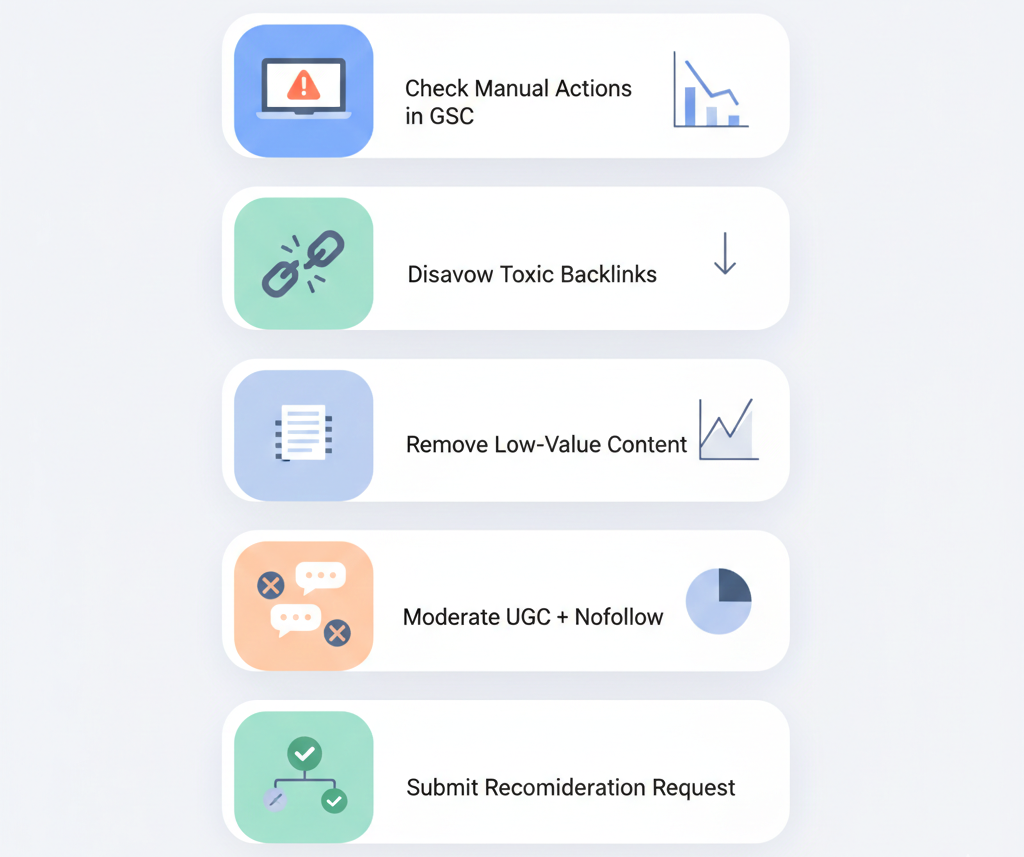
What should I do if I have a manual action?
Don’t panic but act fast.
Step 1: Understand the exact violation
Step 2: Fix the root cause
Step 3: Document everything
Step 4: Submit reconsideration request
Moreover, your reconsideration request must be honest.
Google wants to see:
- What caused the issue
- What actions you took
- Proof of cleanup
- Commitment to follow guidelines
Do not blame Google. Do not argue. Take responsibility.
What makes a strong reconsideration request?
Keep it clear. Keep it factual.
Include:
- Timeline of problem
- Screenshots of link removal emails
- List of disavowed domains
- Content deletion summary
- Preventive steps implemented
Moreover, avoid emotional language.
Google reviewers want evidence.
I’ve seen reconsideration requests rejected three times because the site owner only wrote two sentences saying, “We fixed it.”
That is not enough.
How long does recovery take?
It depends.
Manual action removal can take:
- 2–4 weeks for review
- 3–6 months for traffic recovery
Moreover, if damage was severe, rankings may not fully return.
Google remembers patterns, therefore, rebuilding trust takes time.
Can competitors trigger manual penalties?
Negative SEO is often exaggerated.
However, unnatural link penalties can be triggered by toxic links.
Moreover, Google is better at ignoring spam links now.
In my experience, 90% of link penalties are self-inflicted.
Therefore, focus on your own link profile first.
How can I prevent manual penalties in the future?
Prevention is cheaper than recovery.
Follow these principles:
- Avoid buying links
- Avoid automated link building
- Publish original content
- Moderate user-generated content
- Follow Google’s spam policies
- Audit backlinks quarterly
Moreover, invest in quality over quantity.
Ten strong backlinks beat 500 spam ones.
Are AI tools causing more manual penalties now?
AI content alone does not trigger penalties.
However, mass-produced low-value content does.
If AI content lacks originality, insight, or usefulness, then it may fall under “thin content.”
Therefore, use AI as a tool, not a replacement for expertise.
Add:
- Real data
- Unique opinions
- Case studies
- Expert commentary
That makes the difference.
Can a manual penalty permanently damage my domain?
Yes, if abused repeatedly.
If a domain receives multiple severe manual actions, then trust declines.
Moreover, rebuilding authority becomes harder each time.
In extreme cases, starting fresh may be cleaner.
However, that should be a last resort.
What is the biggest mistake people make after getting penalized?
They fix symptoms, not causes.
For example:
- Disavowing links without stopping paid link campaigns
- Deleting content but continuing low-value publishing
- Removing spam but not adding moderation
Therefore, Google rechecks and rejects reconsideration.
Manual penalties are not random but they are responses to patterns.
Fix the pattern.
Final thoughts: is my site really manually penalized?
Ask yourself:
- Did I receive a Search Console notification?
- Did traffic drop across most keywords?
- Were pages deindexed?
- Have I engaged in risky SEO practices?
If there is no manual action message, then it is not a manual penalty.
It is likely algorithmic or technical.
However, if you do see a manual action, treat it seriously.
Fix it thoroughly. Document everything. Submit reconsideration carefully.
Moreover, learn from it.
Google penalties are painful. But they are also clear signals.
Clean SEO wins long term.
Shortcuts don’t.
And if you’re unsure, start with Search Console. Always.

Leave a Reply