
Launching a new website is exciting. However, it also brings a big question: does SEO actually help new websites rank, or is it a waste of time early on?
Many guides give vague answers like “SEO takes time” or “just create quality content.” While that is partly true, it is not helpful enough. Therefore, this article shares a clear, realistic, experience-based answer—not theory, not hype.
If you are running a brand-new website or planning to launch one, this guide will help you understand what SEO can and cannot do for you in the early stages.
What “New Website” Really Means in SEO?
Before answering the main question, it is important to define what new means.
In SEO terms, a new website usually falls into one of these categories:
- A brand-new domain with no history
- A new website on an aged domain with little or no prior content
In both cases, Google has limited data about the site. Therefore, rankings do not happen instantly. Most new websites are considered “new” for the first 6–12 months, depending on consistency and quality.
The Short Answer: Yes, SEO Helps—But With Conditions
Yes, SEO does help new websites rank, but not in the way many people expect.
SEO is not a quick traffic hack for new sites. Instead, it is a foundation-building process. When done correctly, it helps Google understand what your website is about?, who your content is for? and why your site deserves trust?
Therefore, SEO works best for new websites that are willing to play the long game and follow proven fundamentals rather than shortcuts.
What Actually Happens When You Do SEO on a New Website?
Many people expect rankings first. However, that is not how SEO works early on.
Here is what usually happens instead:
- Google starts crawling your pages
- Your pages appear for very low-competition or long-tail queries
- Impressions increase before clicks
- A few pages begin ranking, not the whole site
Moreover, this gradual growth is a positive sign. It means Google is testing your content and assessing quality.
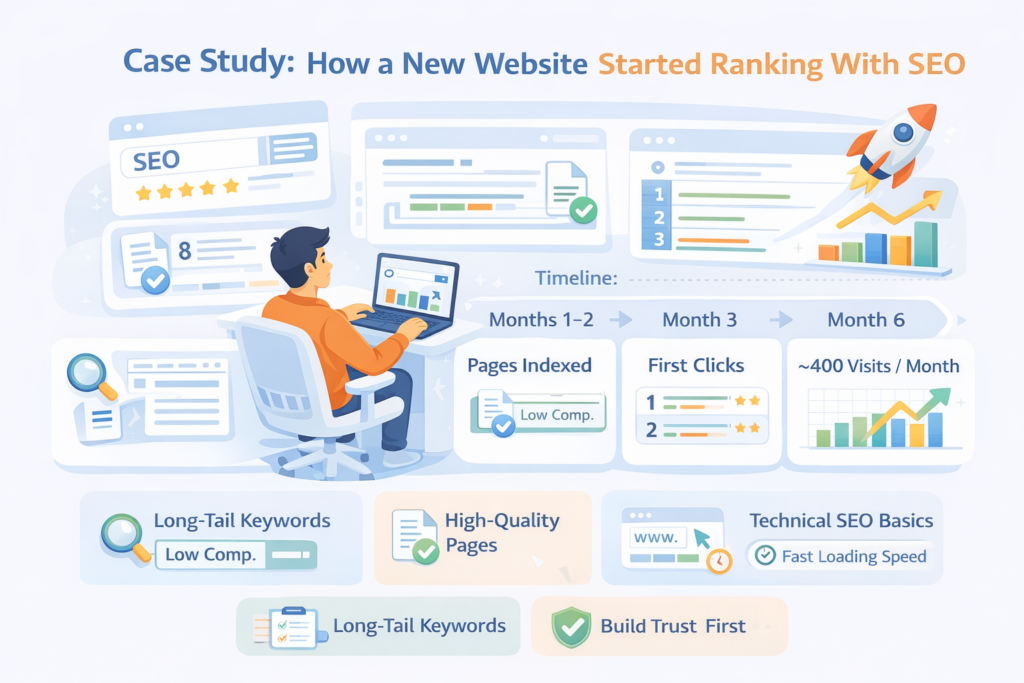
Case Study: How a Brand-New Website Started Ranking With SEO
Background
A service-based website was launched on a brand-new domain with no prior traffic, no backlinks, and no brand recognition. The niche was moderately competitive, but the site focused on a very specific sub-service rather than broad industry terms.
At launch, the website had:
- 0 organic traffic
- No indexed pages
- No domain authority
The goal was simple: validate SEO as a growth channel without relying on ads or aggressive link building.
SEO Strategy Used
Instead of targeting high-volume keywords, the SEO approach focused on clarity and intent.
1. Narrow keyword targeting
The site targeted long-tail, problem-based queries such as:
- “how to [specific service] for small businesses”
- “cost of [specific service] in [location]”
These keywords had low competition but clear user intent.
2. Content built for usefulness, not volume
Only 8 in-depth pages were published in the first three months. Each page:
- Answered one specific question
- Included real examples and explanations
- Avoided filler or generic advice
3. Strong internal linking
Pages were internally linked based on topic relevance. This helped Google understand the site structure early on.
4. Technical basics done right
The site had:
- Clean URLs
- Fast loading speed
- Mobile-friendly design
- Proper indexing setup via Search Console
No backlinks were built during the first phase.
Timeline & Results
Month 1–2
- Pages got indexed
- No traffic
- Search Console started showing impressions
Month 3
- Impressions increased steadily
- First clicks appeared for long-tail keywords
- One page ranked on page 2
Month 4–5
- 3 pages moved to page 1 for low-competition queries
- Organic traffic reached ~150 visits/month
- One inquiry came directly from organic search
Month 6
- Consistent rankings for multiple keywords
- Traffic crossed ~400 visits/month
- SEO became the top-performing channel
All of this happened without backlinks or paid promotion.
What This Case Study Proves?
This example shows that SEO does work for new websites when expectations are realistic.
More importantly, it proves that:
- Rankings don’t come first—impressions do
- Topical relevance matters more than domain age early on
- You don’t need backlinks immediately to see progress
Therefore, SEO helped the website build momentum, trust, and predictable growth over time.
Key Takeaway
SEO did not create overnight success. However, it created a foundation that continued to compound month after month.
For new websites, that is exactly what SEO is meant to do.
What is the Biggest SEO Mistake New Websites Make?
The number one mistake is trying to compete with established websites too early.
Many new sites target high-volume keywords, broad topics and competitive commercial terms. As a result, Google has no reason to rank them.
Instead, new websites should focus on specific problems, narrow topics, and underserved queries. This approach builds relevance and topical authority faster.
What Works Best for New Websites? (Early SEO Focus)
SEO for new websites should be simple and focused. The following areas tend to deliver the earliest signals of success:
- Clear site structure and internal linking
- Long-tail, low-competition keywords
- Content that directly answers user questions
- Consistent publishing schedule
Moreover, publishing fewer high-quality pages is better than publishing many shallow ones. Depth builds trust.
How Long SEO Takes for New Websites? (Honest Timeline)
Let’s be honest—SEO does not work overnight. However, it does work predictably when done right.
Here is a realistic timeline:
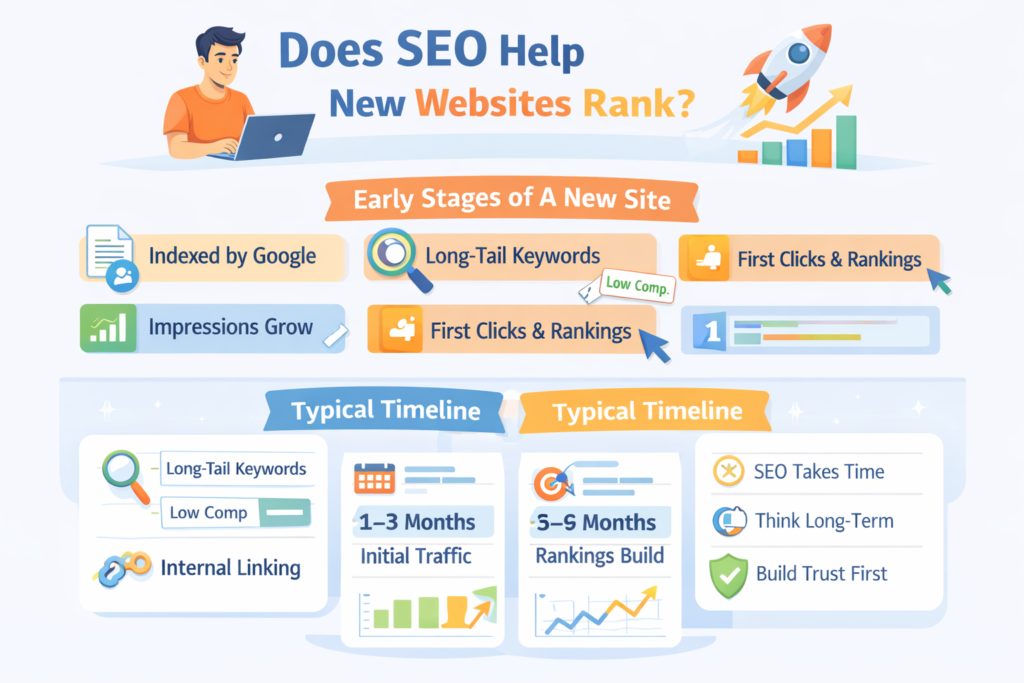
- 1–3 months: Indexing and impressions
- 3–6 months: First clicks and early rankings
- 6–9 months: Stable traffic on select pages
- 9–12 months: Compounding growth
Therefore, if someone expects leads in the first few weeks, SEO alone may feel disappointing. However, for long-term growth, it becomes extremely valuable.
Should New Websites Rely Only on SEO?
In most cases, no.
SEO works best when combined with at least one other channel, such as paid ads for early visibility or social media for distribution or direct outreach or partnerships.
Moreover, these channels support SEO indirectly by generating engagement, brand searches, and user signals. Therefore, SEO should be part of a growth system, not a standalone tactic.
When SEO May Not Be the Right Choice? (Important Honesty)
SEO is not ideal for every new website.
It may not be the best option if you need immediate leads or our niche is extremely competitive or you lack resources to create quality content.
In such cases, paid traffic or outbound strategies may deliver faster results. However, SEO can still be layered in gradually for long-term stability.
Why SEO Is Still Worth It for New Websites?
Despite the slow start, SEO offers benefits that no other channel matches:
- Traffic does not stop when spending stops
- Content compounds over time
- Trust and credibility increase naturally
Moreover, once rankings stabilize, SEO becomes one of the highest-ROI marketing channels available. Therefore, starting early—even slowly—creates a long-term advantage.
One Clear Piece of Advice for New Website Owners
If you remember one thing, remember this:
Do SEO to build trust, not to chase rankings.
Focus on solving real problems, writing content for humans first, and staying consistent. Rankings follow clarity and usefulness—not tricks.
Final Verdict: Does SEO Help New Websites Rank?
Yes, SEO absolutely helps new websites rank. However, it works progressively, not instantly.
When approached with realistic expectations, strategic focus, and patience, SEO becomes one of the strongest growth assets a new website can invest in.
If you are willing to commit to quality and time, SEO is not just helpful—it is essential.

Leave a Reply