
If your website is not showing up on Google, you are not alone. I have worked on hundreds of sites over the last decade, and this issue is far more common than most people realize. Moreover, it rarely has just one cause.
But sometimes Google can’t find your site. Other times it finds it but chooses not to rank it. And in many cases, Google indexed the site at one point but later stopped trusting it.
Therefore, instead of guessing, let’s break this down logically, using real SEO diagnostics, not generic advice.
Why Your Website Isn’t Showing Up on Google at All?
Before talking about rankings, we need to address a more basic problem: visibility.
If your site does not appear anywhere in Google search, even for your brand name, one of the following is almost always true.
Google Has Not Indexed Your Website
Indexing means Google knows your site exists and has also, stored it in its database. No index means no chance to rank.
How to check
- Search:
site:yourdomain.com - Therefore, if nothing appears, Google hasn’t indexed your site.
Real case study
A SaaS startup came to me after six months with zero organic traffic. Their developer had accidentally deployed the site with a global /noindex/ tag. Google crawled the site multiple times and also, ignored it every single time.
Fix
- Removed the /
noindex/ - Resubmitted sitemap
- Requested indexing via Google Search Console
Result
- 312 pages indexed in 14 days
- First organic leads within 30 days
Your Robots.txt Is Blocking Google
This is one of the most overlooked issues.
A single line in robots.txt can block your entire website:
Disallow: /
This tells Google not to crawl anything.
Why this happens
- Developers use it during staging
- It gets pushed live by mistake
- Nobody checks afterward
Therefore, always review your robots file when a site disappears.
Your Pages Exist, But Google Is Ignoring Them
Sometimes Google crawls your site but decides not to index specific pages. In Search Console, you’ll see statuses like:
- Discovered – currently not indexed
- Crawled – currently not indexed
This is not a technical issue but a quality issue.
Therefore, Google is essentially saying:
“This page adds no value compared to what we already have.”
Why Your Pages Are Missing From Google Search Results?
If some pages appear but others don’t, the problem is usually content depth or duplication.
Thin or Duplicate Content
In the last 5 years, Google has become ruthless about low-value pages.
Examples:
- Location pages with only city name changed
- Blog posts rewritten from competitors
- AI content with no original insight
- Product pages with manufacturer descriptions
Real case study
An e-commerce brand had 4,200 pages indexed but only 120 pages ranking.
We audited the site and found:
- 70% of category pages had less than 150 words
- Blog posts repeated the same advice found everywhere else
Fix
- Merged overlapping pages
- Added first-hand data (returns, FAQs and also, buying objections)
- Removed 1,900 low-value URLs
Result
- Indexed pages dropped
- Traffic increased by 184% in 4 months
Therefore, less content and more trust.
Poor Internal Linking Structure
Google discovers as well as understands pages through links. If your pages are isolated, Google treats them as unimportant.
Common problems:
- Orphan pages
- No contextual links
- Navigation too deep
- JavaScript links Google can’t parse
Therefore, every important page must:
- Be reachable within 3 clicks
- Have keyword-relevant internal anchors
- Receive links from authoritative pages
Therefore, internal links are not optional. They are SEO infrastructure.
Why Google Is Not Ranking Your Site? (Even If It’s Indexed)
At this stage, Google knows your site exists. The real question is: why does Google not trust it enough to rank it?
Lack of Topical Authority
Ranking today is not about single keywords but about topic ownership.
If your site has:
- One blog on SEO
- Two posts on website traffic
- One guide on Google rankings
Google sees you not as an expert, but as a generalist.
Real case study
A marketing agency blog was stuck on page 3 for all keywords.
We rebuilt the content strategy:
- One pillar page per topic
- 15–20 supporting articles per pillar
- Strong internal linking structure
Result
- 11 page-one rankings in 90 days
- Average session time doubled
Google rewards depth, not randomness.
Weak Backlink Profile (or the Wrong Links)
Backlinks still matter. However, quality now matters more than ever.
Bad signals include:
- Paid guest posts
- Sitewide footer links
- Irrelevant directories
- Exact-match anchor spam
Good links:
- Earned mentions
- Industry publications
- Real brands
- Contextual placement
Moreover, you don’t need hundreds of links. You need the right ones.
Your Website Sends Poor Trust Signals
Google evaluates trust through multiple layers:
- HTTPS
- Clear ownership
- About and contact pages
- Author credibility
- Real business information
If your site looks anonymous or auto-generated, rankings will suffer.
Therefore show real authors, dd credentials
- Link to LinkedIn profiles
- Publish original insights and case studies
Trust is not a checkbox but it’s cumulative.
How to Make Your Website Appear First on Google Search?
Let’s be honest. Ranking first is not about tricks. It requires alignment between search intent, content depth, authority and also, technical clarity.
Step-by-step framework I use
- Choose one primary keyword per page
- Analyze top 3 ranking competitors
- Create something objectively better:
- updated
- detailed
- practical
- Also Add original data or experience
- Build internal and external links
- Improve engagement metrics
- Time on page
- Scroll depth
- CTR
This process works across niches because it matches how Google actually ranks pages.
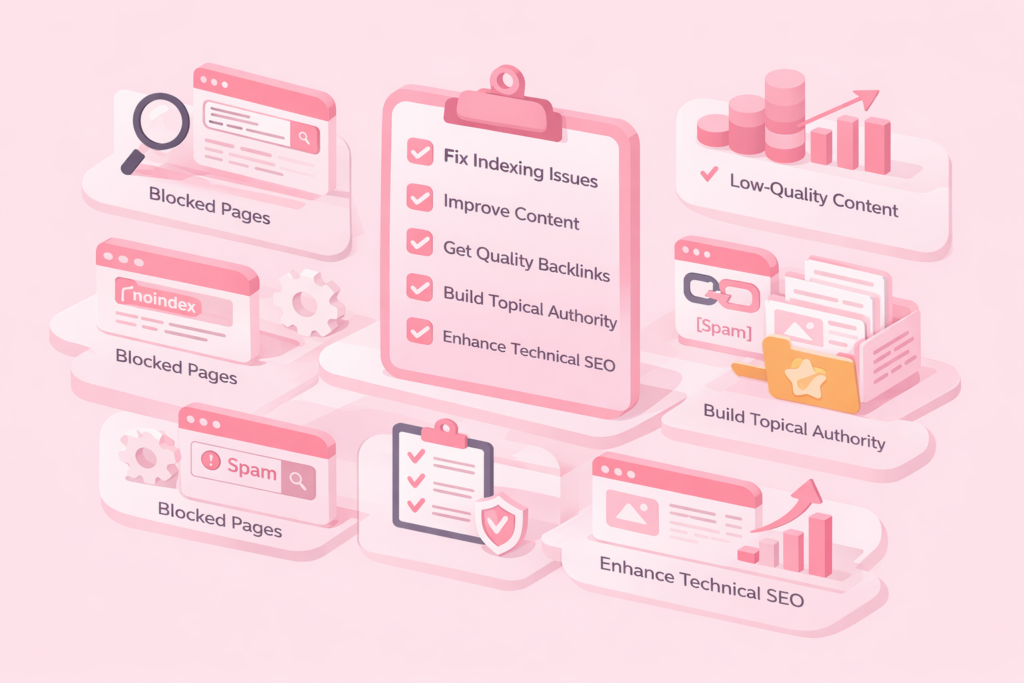
How to Get 1,000 Visitors a Day (Without Chasing Virality)
Most sites fail because they chase traffic instead of systems.
Here is the approach that consistently works.
Focus on Search Demand, Not Volume Alone
A keyword with 300 searches, clear intent and low competition is often more valuable than a 10,000-search keyword you’ll never rank for.
Build Content Clusters
Instead of publishing random posts, create:
- 1 core guide
- 10–20 supporting articles
This builds topical authority and also, compounds traffic.
Update Existing Content Aggressively
In many cases, traffic growth does not come from new content.
It comes from:
- Updating outdated posts
- Improving structure
- Adding missing subtopics
- Refreshing examples
One client reached 1,000 daily visitors by updating 14 existing articles.
No new content needed.
Final Thoughts From 10 Years in SEO
If your website is not showing up on Google, the problem is not Google.
It’s:
- Indexing signals
- Content quality
- Authority gaps
- Trust issues
- Strategic mistakes
SEO is not about hacks but it’s about removing friction between your website and Google’s understanding of value.
Fix the fundamentals. Then build depth. Then earn trust.
That is how sites rank. And more importantly, how they stay ranked.

Leave a Reply