
Many B2B companies still ask the same question: Does SEO really help B2B businesses?
The doubt is understandable. Sales cycles are long. Decision-makers are few. Moreover, deals often close offline, not on a website.
However, based on years of hands-on SEO work with B2B companies, the short answer is yes—SEO helps B2B companies, but not in the way most people expect.
SEO is not about chasing traffic. Instead, it is about building trust, authority, and demand over time. Therefore, when done right, SEO becomes a growth engine for B2B companies.
Let’s break this down clearly.
Why B2B SEO Is Often Misunderstood?
Many B2B leaders believe SEO is only for eCommerce or blogs. Others think LinkedIn or outbound sales are enough. As a result, SEO is either ignored or done half-heartedly.
This is the biggest mistake.
In B2B, buyers research heavily before talking to sales. They compare vendors, read opinions, and look for proof. Therefore, if your company does not appear during this research phase, you are invisible.
SEO places your brand inside the buyer’s decision journey, not just at the end.
How SEO Actually Helps B2B Companies?
SEO does not “close” deals directly. Instead, it supports every stage of the sales funnel.
Here’s how.
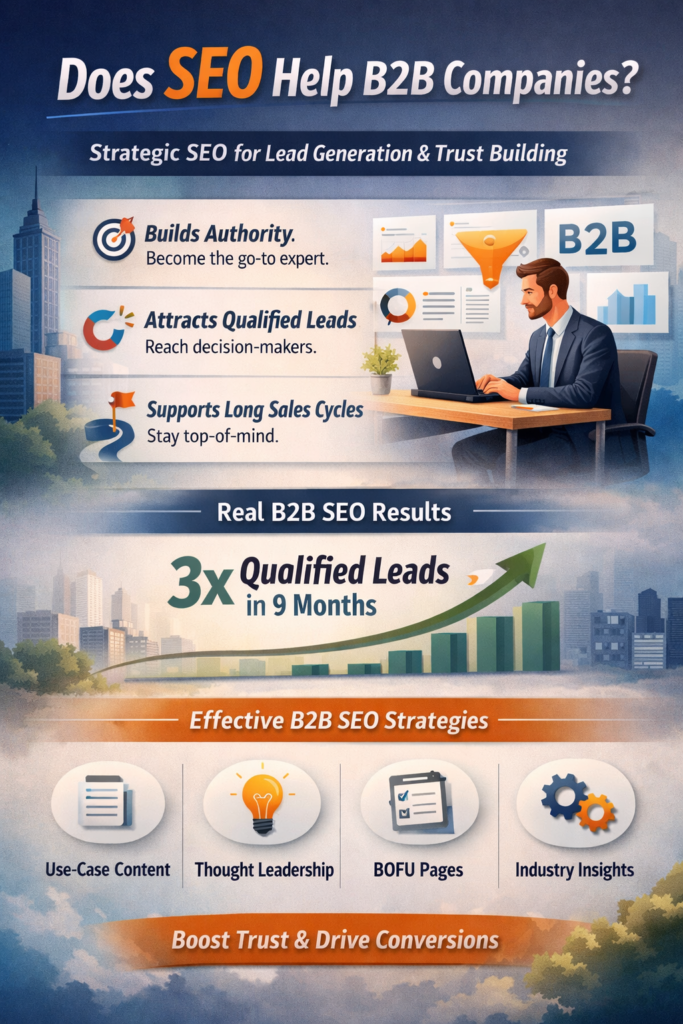
Builds Authority Before the Sales Call
In B2B, trust matters more than clicks.
When a CTO, founder, or procurement manager searches for answers and keeps seeing your brand, something important happens. Your company starts to feel familiar. Moreover, familiarity builds trust.
By publishing in-depth content around problems, use cases, and solutions, you position your brand as an expert. Therefore, when sales outreach happens, prospects already know who you are.
This shortens sales cycles significantly.
Attracts High-Intent, Educated Leads
B2B SEO is not about ranking for broad keywords like “software” or “IT services.” Instead, it focuses on long-tail, intent-driven searches.
For example:
- “CRM for manufacturing companies”
- “SOC 2 compliance checklist for SaaS”
- “ERP integration challenges in logistics”
These searches come from buyers who already understand their problem. Therefore, even low traffic can generate high-quality leads.
In one B2B SaaS project, traffic grew only 40% in six months. However, demo requests increased by over 120%. The reason was simple: we targeted intent, not volume.
Supports Long Sales Cycles
B2B buyers rarely convert after one visit. They return many times.
SEO content such as comparison pages, use-case guides, and solution explainers supports this long journey. Moreover, each visit reinforces your authority.
Therefore, even if SEO does not generate an immediate lead, it influences the final decision.
Many deals that look like “sales-led wins” are actually SEO-assisted conversions.
A Real-World B2B SEO Case Study
Let’s look at a real example.
A mid-size B2B service company relied heavily on outbound sales. Their website existed, but it did not generate leads. Blog posts were generic and written for keywords, not people.
What we did:
- Identified real sales objections from calls
- Created content answering those exact questions
- Built use-case and industry-specific pages
- Optimized internal linking for decision paths
The result:
- Organic traffic grew steadily, not explosively
- Sales-qualified leads increased by 3× in 9 months
- Sales teams reported warmer, more informed prospects
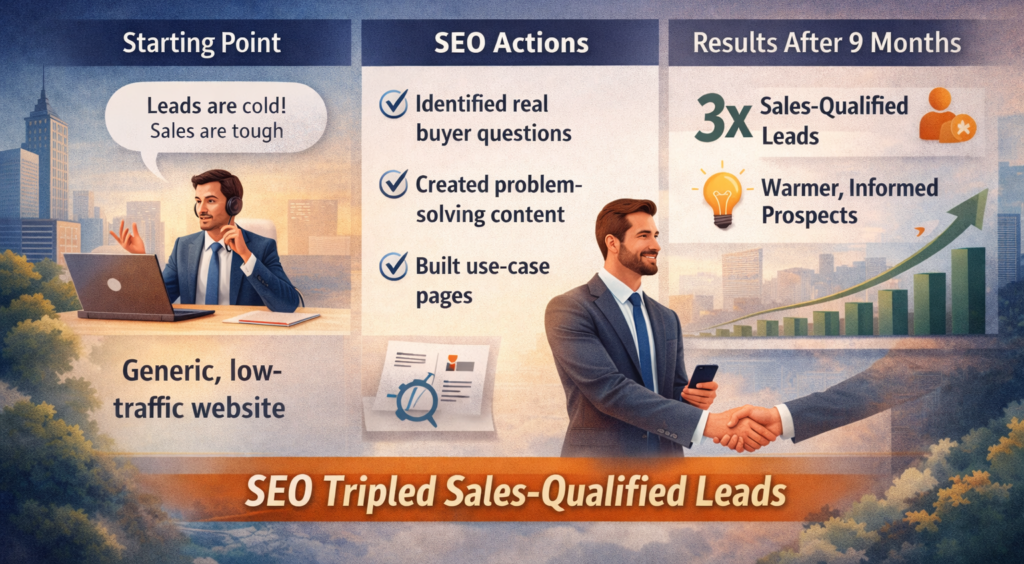
Therefore, SEO did not replace sales. It made sales more effective.
What SEO Goals Should B2B Companies Focus On?
Many B2B teams track the wrong metrics. Rankings and traffic look good on reports, but they don’t always move revenue.
Instead, B2B SEO should focus on:
- Lead quality, not lead quantity
- Brand searches over time
- Assisted conversions
- Content influence on sales
Moreover, SEO success often shows up in sales conversations, not dashboards.
If prospects say, “I read your article” or “I’ve seen your company before,” SEO is working.
SEO Strategies That Work Best for B2B
Not all SEO tactics work for B2B. However, a few consistently deliver results.
Problem-Led Content
Content should start with real problems, not keywords. Therefore, interviews with sales teams are gold.
Use-Case & Industry Pages
Generic service pages don’t convert. Specific ones do.
Thought Leadership
Opinionated content builds authority faster than safe, generic posts.
Bottom-of-Funnel SEO
Comparison pages, alternatives pages, and decision guides matter more than blog volume.
Moreover, consistency matters more than frequency.
Common B2B SEO Mistakes to Avoid
Many B2B companies fail at SEO for predictable reasons.
- Writing content for search engines, not buyers
- Expecting SEO to work in 2–3 months
- Measuring success only by traffic
- Ignoring internal buy-in from sales teams
SEO works best when marketing and sales collaborate. Therefore, alignment is non-negotiable.
Who Benefits Most from B2B SEO?
SEO is especially powerful for:
- B2B SaaS companies
- Professional service firms
- High-ticket solution providers
- Companies targeting global or niche markets
If your buyers search before they buy, SEO helps. It’s that simple.
Final Answer: Does SEO Help B2B Companies?
Yes. SEO absolutely helps B2B companies.
However, it works strategically, not magically.
When SEO is treated as a trust-building, demand-creating channel, it becomes one of the most cost-effective long-term growth levers. Moreover, it compounds over time.
SEO will not replace sales.
But it will make every sales effort stronger.
And in B2B, that makes all the difference.

Leave a Reply