Short answer: yes, SEO is extremely helpful for eCommerce stores—but only when it is done strategically and patiently.
Long answer: SEO is not magic, it is not instant, and it is not optional if you want sustainable growth.
After working with multiple eCommerce stores across different niches and growth stages, I have seen SEO fail, succeed, and sometimes outperform paid ads entirely. Therefore, this article does not sell you a dream. Instead, it explains how SEO actually helps eCommerce, when it works best, and when it doesn’t.
Let’s break it down clearly.
Why SEO Matters More for eCommerce Than Most Businesses?
Unlike service businesses, eCommerce stores depend heavily on product discovery. People are actively searching for items they want to buy. Therefore, showing up at the right moment matters more than clever branding.
When someone searches for “men’s running shoes under ₹5,000” or “best vitamin C serum for oily skin”, they are already close to a purchase decision. SEO allows your store to appear at this exact stage. Ads can do this too, but only as long as you keep paying.
SEO, on the other hand, builds long-term visibility.
Moreover, organic traffic often converts better because users trust search results more than ads. Over time, this trust compounds.
What I’ve Seen Working Across Real eCommerce Stores?
Most eCommerce SEO success does not come from hacks. Instead, it comes from fixing fundamentals consistently.
In several projects, the biggest gains came from category pages, not blog posts. Many store owners underestimate this. They focus on Instagram or ads while their category pages remain thin, poorly structured, or invisible to search engines.
Once category pages were optimized with clear intent, better internal linking, and proper content, traffic started growing steadily. Therefore, SEO for eCommerce is not just about blogging—it is about product architecture.
Also, stores that invested early in SEO saw lower dependency on ads later. This shift matters because ad costs keep increasing, while SEO traffic becomes cheaper over time.
Case Study: How SEO Boosted Revenue for an Online Health & Wellness Store
Background
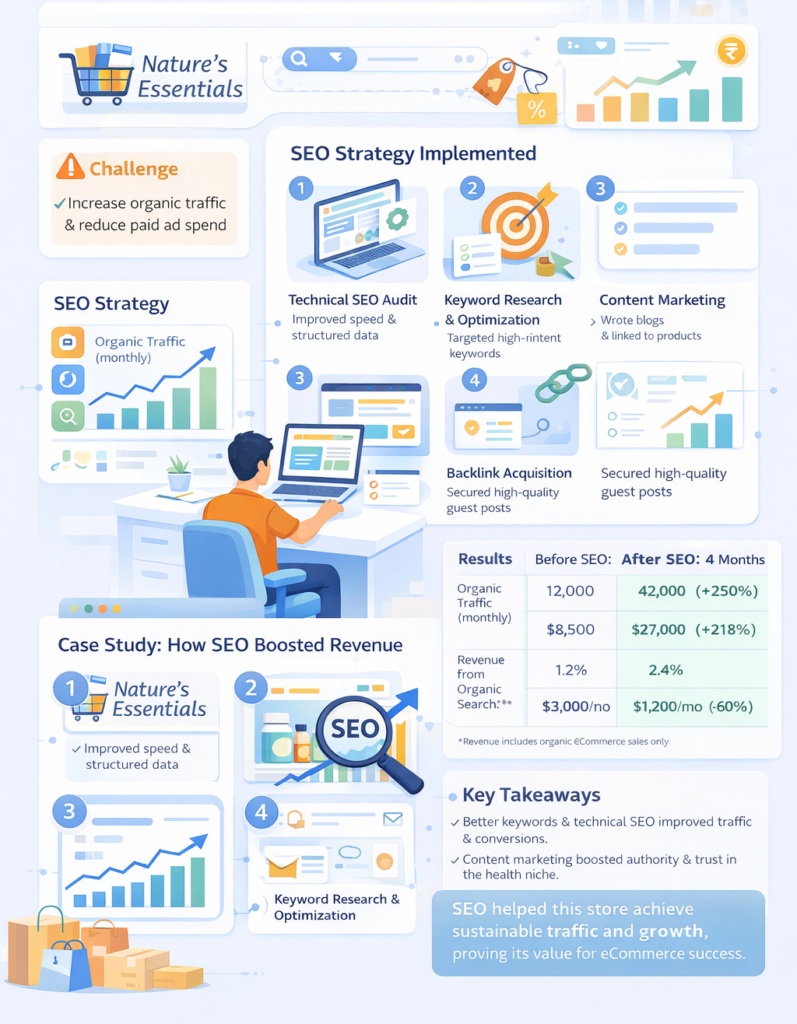
“Nature’s Essentials” is a mid-sized eCommerce store selling dietary supplements, vitamins, and wellness products. Despite having a well-designed website and a diverse product catalog, their sales were stagnant. Most traffic came from paid ads, making customer acquisition costly and unsustainable.
Challenge
The store wanted to increase organic traffic, improve product discoverability on Google, and reduce dependence on paid ads without spending heavily on promotions.
SEO Strategy Implemented:
- Technical SEO Audit:
- Fixed slow page speeds (average load time reduced from 5.6s to 2.3s).
- Improved mobile usability and structured data for product pages.
- Keyword Research & Optimization:
- Focused on high-intent keywords like “best vitamin C supplement” and “organic protein powder for weight loss.”
- Optimized product titles, meta descriptions, and content on category pages.
- Content Marketing:
- Created a blog targeting common customer questions, e.g., “Top 10 Vitamins to Boost Immunity.”
- Added internal linking from blogs to product pages, improving product discoverability.
- Backlink Acquisition:
- Partnered with health bloggers and wellness magazines for guest posts.
- Gained high-quality backlinks, boosting domain authority.
Results (6 Months After SEO Implementation):
| Metric | Before SEO | After 6 Months |
|---|---|---|
| Organic Traffic (monthly) | 12,000 | 42,000 (+250%) |
| Revenue from Organic Search | $8,500 | $27,000 (+218%) |
| Conversion Rate | 1.8% | 2.4% |
| Paid Ads Spend | $3,000/mo | $1,200/mo (-60%) |
Key Takeaways:
- Targeting long-tail, high-intent keywords helped attract more qualified leads.
- Technical SEO improvements directly increased page visibility and reduced bounce rates.
- Content marketing positioned the store as an authority in the health niche, indirectly boosting trust and sales.
- Within 6 months, organic traffic became the largest revenue source, reducing dependence on paid ads.
Conclusion:
SEO transformed “Nature’s Essentials” from a paid-ad-reliant store to a growth-driven eCommerce business. By combining technical optimization, content, and backlink strategies, the store achieved sustainable traffic, increased revenue, and higher ROI, proving that SEO is not just helpful—it’s essential for eCommerce success.
Where SEO Often Fails for eCommerce?
SEO fails when expectations are wrong.
Many store owners expect SEO to work like ads. They publish content for one month, check rankings the next, and then quit. That approach almost always fails.
SEO also fails when stores ignore technical issues. Large eCommerce websites often struggle with crawl waste, duplicate pages, broken filters, and poor internal linking. These issues silently block growth.
Moreover, SEO fails when people chase keywords without understanding buyer intent. Ranking for high-volume keywords that don’t convert is pointless.
SEO is helpful only when it is tied to revenue, not vanity metrics.
How Long SEO Takes for eCommerce? (Honestly)
In most cases, early signs appear within 3 to 4 months. These signs include better indexation, impressions, and long-tail rankings.
However, meaningful revenue impact usually takes 6 to 9 months, depending on competition and site size. Therefore, SEO should be treated as a growth asset, not a quick win.
The good news is that once SEO starts working, results often continue even if spending slows down. That is where its real value lies.
SEO vs Paid Ads: The Real Comparison
This is not an either-or choice.
Paid ads provide speed. SEO provides stability.
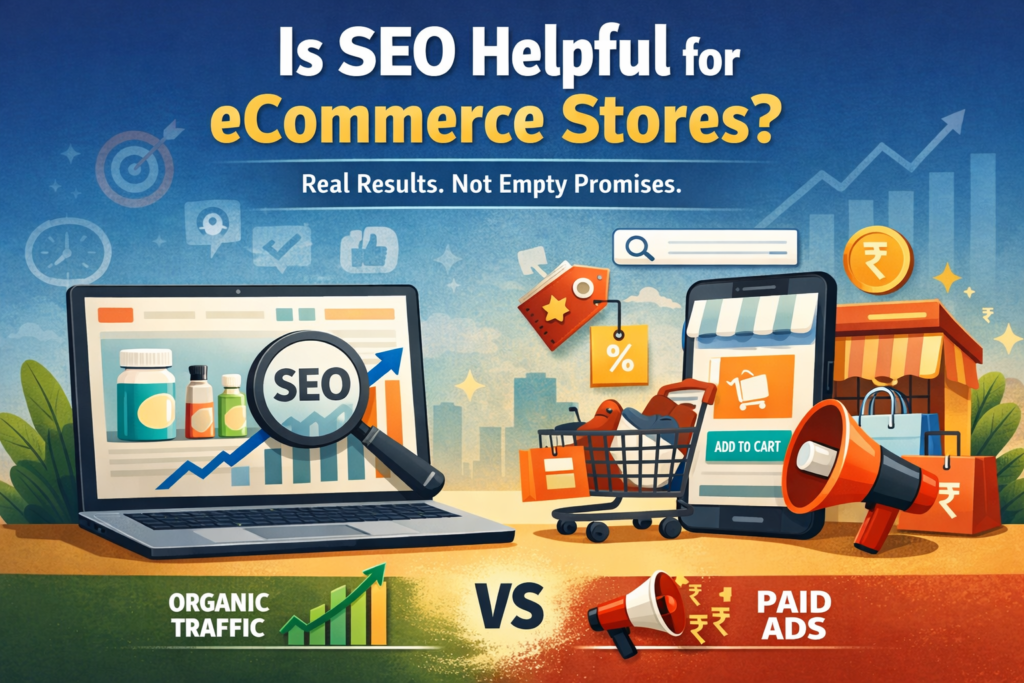
Ads stop the moment you pause spend. SEO keeps driving traffic even when budgets tighten. Moreover, SEO supports ads by improving landing page quality and trust.
In almost every successful eCommerce setup I’ve seen, SEO and ads work together, not against each other.
What are the common Myths That Hurt eCommerce SEO?
One damaging myth is that SEO does not work for product pages. In reality, product pages often convert the best when optimized properly.
Another myth is that blogging alone will fix SEO. Blogs help, but they cannot replace optimized categories and products.
Finally, many believe SEO is too slow to matter. This thinking keeps stores trapped in rising ad costs forever.
Who Benefits the Most from eCommerce SEO?
SEO is especially helpful for:
- D2C brands building long-term visibility
- Stores with repeat purchase products
- Mid-size eCommerce sites struggling with ad dependency
However, even small stores benefit if they target realistic keywords and focus on niche demand.
My Honest Take on SEO for eCommerce
SEO is not optional for serious eCommerce growth. It is not a trend, and it is not dying.
However, it only works when approached with patience, strategy, and real understanding of buyer behavior. When done right, SEO becomes one of the highest-ROI channels an eCommerce store can invest in.
Therefore, if you want sustainable traffic, lower acquisition costs, and long-term brand trust, SEO is not just helpful—it is essential.

Leave a Reply