
Can a negative news article really be removed from Google? Yes, sometimes it can.
However, it cannot be removed in every case.
After 10 years in SEO, I know one thing clearly. Google follows rules, not feelings.
Therefore, removal depends on facts, policies, and law. It also depends on who published the article and why. If the content breaks a rule, then, removal is possible. However, if it is true and published by a strong site, suppression works better.
This guide explains both options. Also, it focuses on real results, not fluff.
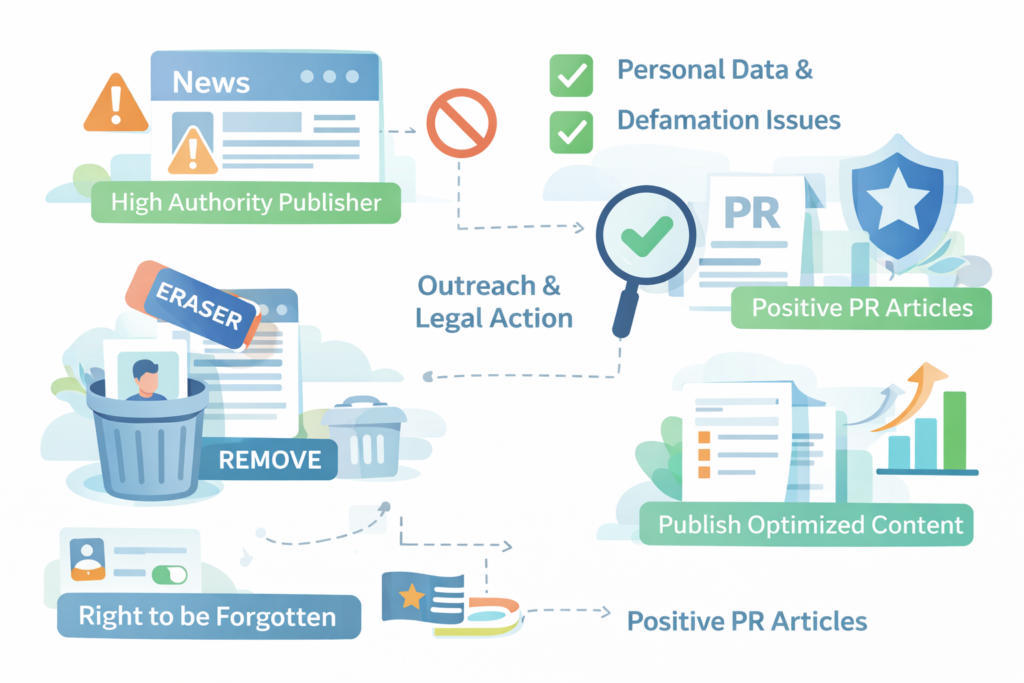
Why do negative news articles rank so high?
Google trusts news sites. Also, these sites usually have high authority and strong backlinks. Therefore, Google assumes their content is credible.
News articles match what people search for. For example, if someone searches your name, Google expects news. As a result, even one article can stay on page one for years.
Freshness matters too. New articles rank fast. Consequently, acting early is important.
Can you really remove a news article from Google?
Yes, but only in certain cases.
Google does not remove content just because it is harmful.
However, it will remove content that breaks its policies or the law.
You can request removal if the article has personal information, defamatory statements or copyright issues.
Therefore, start with a careful audit.
Also, check Google’s removal rules before taking action.
What is the difference between removing and suppressing an article?
Removal means the page is gone from Google. Suppression means the page still exists but is not visible on page one.
In real life, suppression works more often. Therefore, most experts focus on suppression first. It also gives you more control.
Removal depends on publishers or courts. However, suppression depends on smart SEO.
How can Google’s policies help remove negative articles?
Google allows removal in certain situations. For example, it removes pages with personal phone numbers or home addresses.
Therefore, check the article carefully. Also, many articles accidentally break rules.
Case Study
A business consultant had an article showing his phone number.
We filed a Personal Information Removal request.
As a result, Google removed the URL in 11 days.
This works when rules are clear.
However, it does not work for opinions or news facts.
Can defamation claims remove a negative article?
Yes, but you need proof. Google does not decide what is true.
Therefore, a court must prove defamation first.
If you have a court order or a legal notice, then, Google often removes the article.
Also, many publishers delete content after receiving legal notices.
Case Study
A startup founder was wrongly accused in a news blog.
We sent a legal notice with proof.
The publisher removed the article within a week.
Then, we used Google’s outdated content tool.
Consequently, the article disappeared from search.
How should you contact a publisher for removal?
Direct contact works. However, tone is important.
Never threaten, instead, present facts clearly.
Also, show proof of errors.
You can request:
- Corrections
- Updates
- Partial removal
- A noindex tag
Therefore, polite professionalism works best.
Editors respond to facts, not anger.
Does the Right to be Forgotten help remove articles?
In some countries, yes. It mainly works in the EU.
It applies if:
- The content is old
- It no longer matters
- It hurts your reputation
Therefore, it is useful for outdated issues.
However, results vary by country.
This does not delete content.
It only removes it from search results.
What if the article is true but harmful?
This is common.
Unfortunately, true content rarely gets removed.
Therefore, SEO suppression is the best approach.
Suppression pushes the article off page one.
Also, page two is usually invisible to readers.
In reputation SEO, visibility equals impact.
Consequently, suppression protects your reputation.
How does SEO suppression work?
SEO suppression uses Google’s own ranking rules.
It is not manipulation.
It is smart optimization.
We focus on:
- Brand-controlled pages
- PR placements
- High-authority content
Also, suppression works faster for unique names.
Common names take more effort.
What types of content outrank negative articles?
Not all content works.
Therefore, you need strategy.
The best options include:
- Optimized brand websites
- PR articles on trusted sites
- LinkedIn profiles
- YouTube videos
- Google Business listings
Also, these pages match search intent.
Thin, random blogs do not work well.
How long does it take to suppress a negative article?
It depends on the publisher.
- Small sites: 2–3 months
- Medium sites: 4–6 months
- Large national media: 6–12 months
Also, consistency is more important than speed.
Stopping early loses results.
Can PR campaigns help?
Yes. PR is very effective.
Also, Google trusts news mentions.
PR builds:
- Authority
- Trust
- Backlinks
Case Study
A fintech CEO had a negative article at #2.
We published PR articles across business media.
As a result, the negative article dropped to page three in five months.
PR plus SEO works best.
Therefore, combining both is ideal.
Should you optimize content with your personal name?
Yes, always.
Name-based SEO is critical.
You should control:
- Your domain
- LinkedIn profile
- Author pages
- Interviews
Also, Google sees names as entities.
Entity control changes search results.
Does updating old content help?
Yes, very much.
Google likes fresh content.
Update:
- Headlines
- Links
- Schema
- Publication dates
Therefore, refresh old pages regularly.
Also, refreshed content can outrank negative articles.
Do backlinks help?
Yes, but use them correctly.
Strengthen positive pages.
Do not attack negative ones.
Quality beats quantity.
Therefore, one strong link is better than ten weak ones.
Should you use Google’s outdated content tool?
Yes, when relevant.
It works only if content changes or is removed.
It does not work for opinions.
Therefore, use it carefully.
What mistakes should you avoid?
Many people panic and act fast.
This causes mistakes.
Avoid:
- Spam links
- Fake reviews
- Thin content
- False legal threats
Also, shortcuts usually fail.
Can removed articles come back?
Yes, sometimes.
Scraped copies or syndications appear.
Therefore, monitor search results.
Also, use alerts to track changes.
Reputation management is ongoing.
It is not a one-time task.
Is hiring a reputation expert worth it?
Yes, usually.
News suppression is tricky.
It needs:
- SEO expertise
- PR experience
- Legal knowledge
Also, mistakes can make results worse.
How much does it cost?
Costs vary.
Ignoring the problem costs more.
Legal removals are cheaper.
SEO suppression costs more.
PR campaigns cost medium to high.
Therefore, think long-term.
What is the safest long-term strategy?
Authority building.
Nothing beats it.
This includes:
- Continuous PR
- Owning content
- Thought leadership
Therefore, future negative content struggles to rank.
Can you prevent new negative articles?
Partially, yes.
A strong brand dominates search results.
Also, Google favors established entities.
Proactive SEO reduces future damage.
Final thoughts: remove or suppress?
Ask these questions:
- Is it false or illegal? → Remove
- Is it true but harmful? → Suppress
- Is it old or outdated? → Challenge
After 10 years in SEO, I know this:
Negative news does not disappear on its own.
However, with the right plan, it becomes invisible.
And in Google search, invisibility is power.

Leave a Reply