After a decade in SEO and digital marketing, I’ve learned one hard truth: most “best AI tools” lists are written by people who’ve never used the tools in real campaigns.
In 2026, AI is everywhere. However, budgets are tighter, clients are more skeptical, and Google’s AI-powered search has raised the bar for quality. Therefore, free AI tools are no longer about shortcuts—they’re about working smarter without sacrificing trust, originality, or results.
This article shares free AI tools I’ve personally used, where they help, where they fail, and also how to use them responsibly in modern marketing.
What “Free AI Tools” Actually Means in 2026
Before we begin, let’s be honest.
In 2026, truly unlimited free tools barely exist.
So when I say “free,” I mean tools:
- with generous free tiers
- usable for real marketing work, not demos
- that don’t lock essential features behind paywalls immediately
Moreover, every tool listed below has been used either in client SEO campaigns, content workflows, or internal marketing systems.
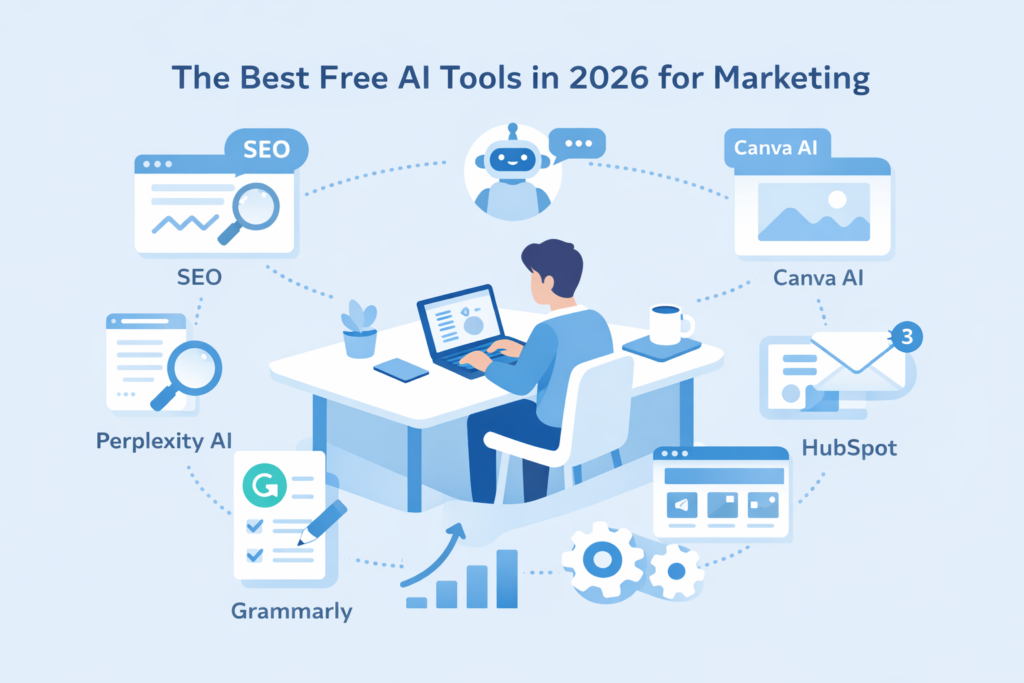
Google Search Generative Experience (SGE) + Search Console
Category: SEO & Search Intelligence
Cost: Free
Google’s AI-powered search has changed SEO completely. Therefore, ignoring SGE data is no longer an option.
While SGE itself isn’t a traditional “tool,” pairing it with Google Search Console gives powerful insights:
- Which pages are cited in AI answers
- How intent is shifting from keywords to topics
- What content Google trusts enough to summarize
How I use it:
I analyze impression spikes without clicks and as a result, often, these pages appear in AI summaries. Therefore, I optimize them for entity clarity, structure, and freshness, not keyword density.
Limitations:
No direct AI analytics yet you still need interpretation skills.
ChatGPT (Free Version) for SEO Ideation & Drafting
Category: Content & Strategy
Cost: Free tier
Let’s clear something up: ChatGPT does not replace SEO writers. However, used correctly, it saves hours.
I use it for:
- Content outlines aligned to search intent
- FAQ expansion from People Also Ask data
- Rewriting content for clarity as well as reading ease
Moreover, I never publish AI output without heavy editing. Google’s 2025–26 updates reward experience-backed content, not polished fluff.
Real result:
Using ChatGPT for outlines reduced content planning time by ~40% on a SaaS blog while maintaining rankings.
Canva AI (Free Plan) for Visual SEO & CTR
Category: Design & Branding
Cost: Free
Visuals influence rankings indirectly through CTR and also dwell time. Therefore, Canva AI has become essential.
Free features I regularly use:
- AI image resizing for featured images
- Text-to-design layouts
- Brand consistency across blog visuals
Case insight:
After updating old blog posts with cleaner visuals using Canva AI, average time on page, therefore, increased by 18% for a local services website.
Limitation:
Advanced brand kits are paid, but free is enough for most marketers.
Perplexity AI (Free) for Research & Fact Validation
Category: Research & Content Accuracy
Cost: Free
Perplexity is not a writing tool – instead, it’s a thinking tool.
I use it to:
- Validate claims before publishing
- Find recent data points quickly
- Cross-check competitor content accuracy before publishing
Therefore, it’s especially useful for YMYL-adjacent content where credibility matters.
Why it matters in 2026:
AI search penalizes outdated or unverifiable claims faster than ever.
Grammarly Free for Readability Optimization
Category: Content Quality
Cost: Free
SEO in 2026 is deeply tied to readability as well as clarity. Google may not “score” grammar, but users do.
Grammarly Free helps with:
- Passive voice reduction
- Sentence clarity
- Tone consistency
Moreover, it directly improves Flesch Reading Ease, which matters for broad audiences.
Notion AI (Limited Free) for Marketing Systems
Category: Workflow & Planning
Cost: Limited free usage
Marketing success isn’t just tools, instead, it’s systems.
I use Notion AI to:
- Turn meeting notes into task lists
- Summarize campaign learnings
- Document SEO SOPs
Therefore, teams move faster without constant meetings.
HubSpot Free AI Tools for CRM & Email Copy
Category: Email & CRM
Cost: Free tier
For SMBs, HubSpot’s free AI features are underrated.
Use cases:
- Email subject line suggestions
- CRM automation summaries
- Lead follow-up drafting
Real outcome:
A service-based client improved email open rates by 11% using AI-refined subject lines while the offer remained unchanged.
What Most Marketers Get Wrong About Free AI Tools?
After reviewing hundreds of AI-driven campaigns, here’s what fails most often:
- Blindly publishing AI-written content
- Using AI without original insights
- Chasing tools instead of outcomes
Therefore, AI should assist expertise, not replace it.
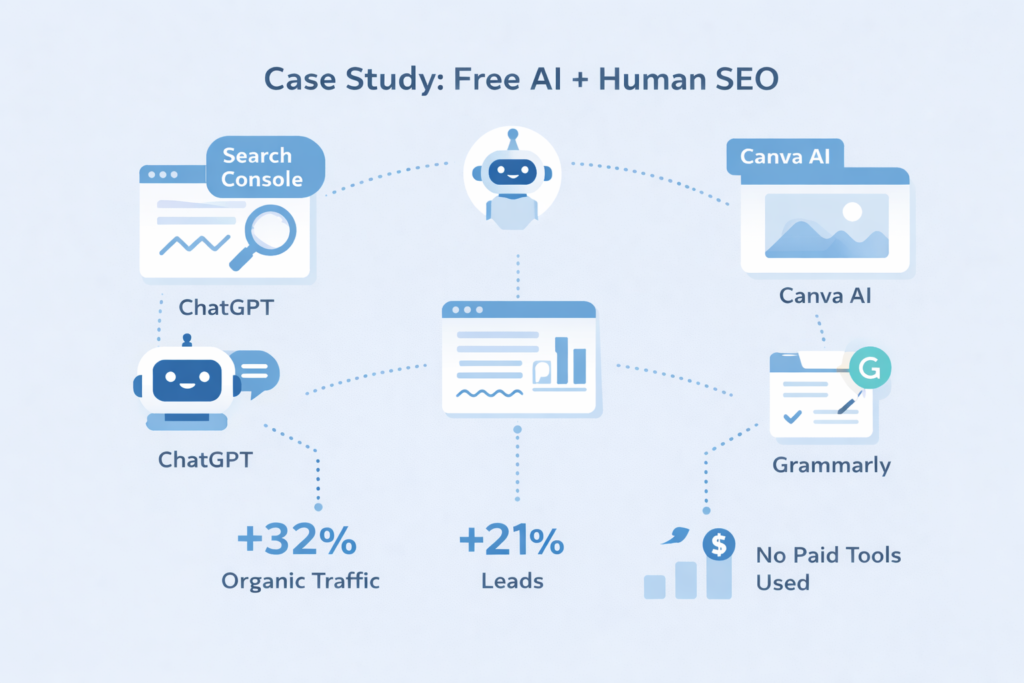
A Realistic Case Study: Free AI + Human SEO
Client: Local B2B service business
Budget: Near zero
Tools used: ChatGPT Free, Search Console, Canva AI, Grammarly
Process:
- Used Search Console to identify low-CTR pages
- Rewrote intros using ChatGPT (human-edited)
- Improved readability with Grammarly
- Added visuals via Canva AI
Result in 3 months:
- +32% organic traffic
- +21% increase in leads
- No paid tools required
My SEO Perspective on AI in 2026
AI is no longer impressive by itself – instead, what matters is:
- Judgment
- Experience
- Strategic restraint
Free AI tools are powerful only when paired with human insight. Therefore, marketers who win in 2026 will not be those who automate everything—but those who use AI to amplify what they already know works.
Final Thought
If you’re expecting free AI tools to replace strategy, they won’t.
However, if you use them to save time, improve clarity, and scale expertise, they can outperform expensive stacks.
That’s not hype—that’s experience.

Leave a Reply