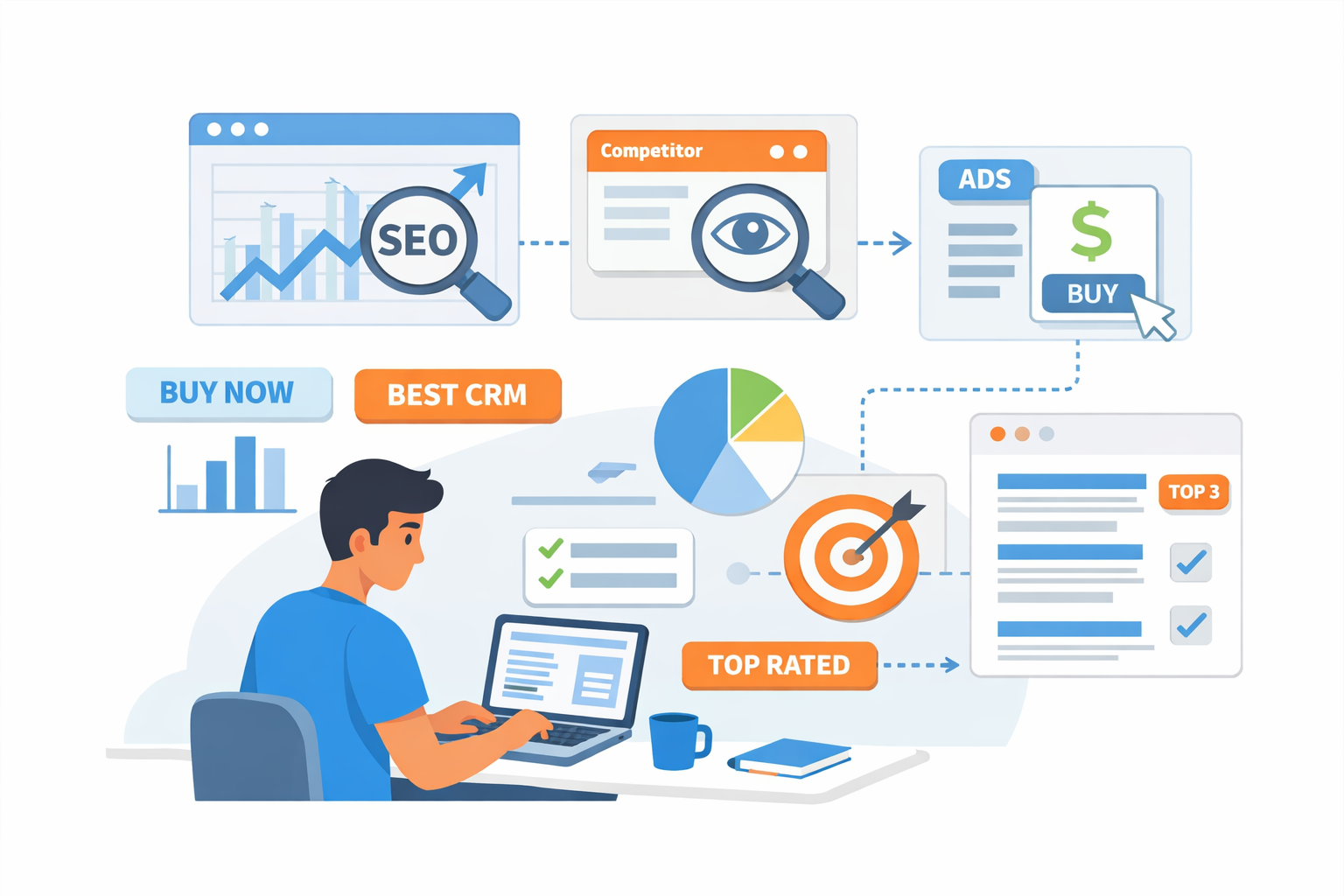
I have been doing SEO for over 10 years. I have audited hundreds of websites. Ecommerce. SaaS. Local businesses.
The pattern is always the same.
Winners do not guess keywords, instead, they steal them legally.
Therefore, this guide is not theory. It is exactly how I do competitor keyword research to drive sales. No fluff. No jargon. Just execution.
Why Should I Care About Competitor Keywords Instead of My Own Ideas?
Because your competitors already paid for the learning curve. They spent money on ads, tested pages and failed fast.
Therefore, when you study their keywords, you shortcut years of mistakes.
Moreover, competitor keywords reveal buyer intent, not vanity traffic.
What Are “Sales-Driven” Keywords Actually?
Not all keywords make money. Some only bring visitors.
Sales-driven keywords usually have clear intent, product or service context as well as commercial modifiers.
Examples:
- “best CRM for small business”
- “hire SEO agency in NYC”
- “Shopify abandoned cart software pricing”
Therefore, focus on intent, not volume.
How Do I Identify My Real Online Competitors?
This is where most people mess up.
Firstly, your business competitors are not always your SEO competitors.
Do this instead:
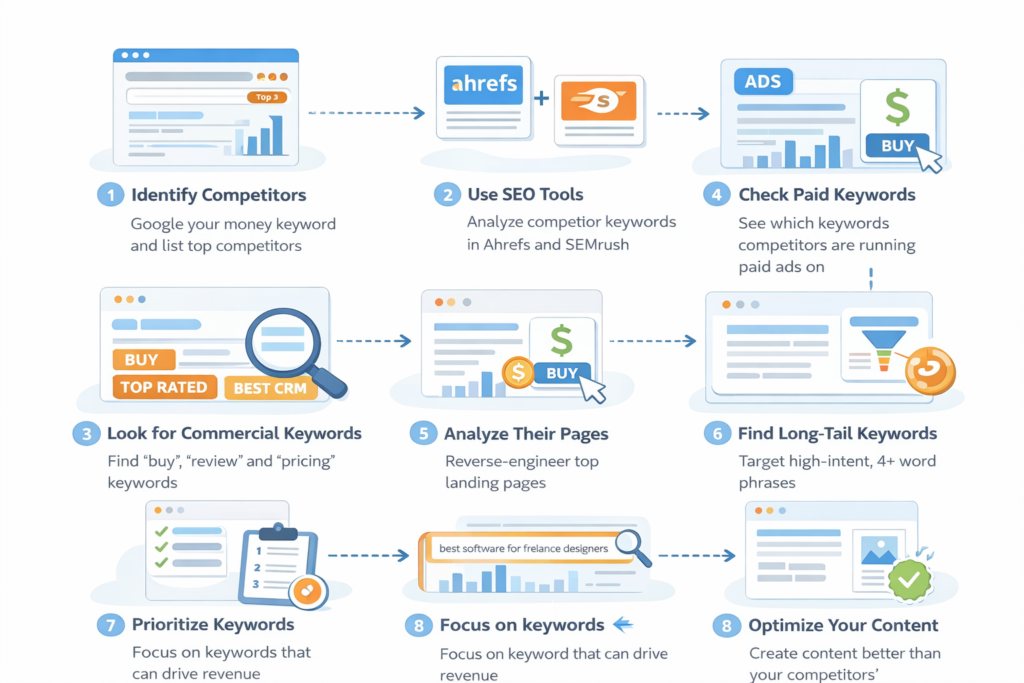
- Google your main money keyword
- Note the top 10 ranking sites
- Ignore big marketplaces if you can’t beat them
Therefore, your SEO competitors are the ones ranking where you want to rank.
Which Tools Do Professionals Use to See Competitor Keywords?
I use tools.
But I do not blindly trust them.
The core stack: Ahrefs, SEMrush, Google Ads Keyword Planner and also, Google Search (manual checks) .
Moreover, tools show data and humans add judgment.
How Do I Find Competitor Keywords Using Ahrefs Step by Step?
This is my daily workflow.
- Enter competitor domain in Ahrefs
- Go to Organic Keywords
- Filter by position (Top 10)
- Filter by intent (commercial / transactional)
Therefore, you instantly see what is working.
Real Case Study
A D2C skincare brand I worked with in 2023 did this.
Result?
- Found 47 keywords competitors ranked for
- 19 had buying intent
- Created better landing pages
Moreover, revenue increased by 38% in 4 months.
How Do I Use SEMrush to Uncover Hidden Sales Keywords?
SEMrush shines at keyword gaps.
Steps:
- Use Keyword Gap Tool
- Add your site and competitors
- Select “Missing” and “Weak” keywords
Therefore, you see keywords competitors rank for and you do not.
Also, check CPC values, SERP features and page types ranking. Also, high CPC usually means money keywords.
How Can I Find Keywords Competitors Are Running Ads On?
Ads reveal what converts because no one runs ads for fun.
Steps:
- Enter competitor domain in SEMrush
- Go to Advertising Research
- Sort by traffic and CPC
Therefore, you see keywords they are paying for monthly.
Moreover, organic SEO pages often mirror paid keywords.
How Do I Reverse Engineer Competitor Landing Pages?
Keywords alone are useless without context.
Therefore, study the page.
Check URL structure, headings, CTA placement and also, internal links.
Ask yourself: But why does this page convert?
Case Study
A B2B SaaS client copied nothing. They improved everything.
- Shorter copy
- Clear pricing table
- Better FAQ
Result? Conversion rate went from 1.2% to 3.6%.
How Do I Find Long-Tail Keywords Competitors Are Quietly Monetizing?
Long-tail keywords are gold. They convert better as well as rank faster.
Use Ahrefs filters:
- Word count: 4+
- Volume: 50–500
- Intent: commercial
Therefore, you find keywords competitors rely on silently.
Example:
“best accounting software for freelance designers”
Low volume. High intent. High ROI.
How Do I Analyze Competitor Blog Content That Generates Sales?
Blogs sell indirectly. Look for comparison articles, alternatives pages and also, best-of lists.
Examples:
- “X vs Y”
- “Best tools for…”
- “Top software for…”
Moreover, these pages often link to money pages.
Therefore, they drive assisted conversions.
How Can Google Search Alone Reveal Competitor Keywords?
Free method as well as very effective.
Do this:
- Type competitor brand and also, product keywords
- Use “site:competitor.com” searches
Example:
site:competitor.com "best"
Therefore, you uncover how they structure sales content.
How Do I Use Google Search Console Data Against Competitors?
You cannot see competitor GSC but you can infer patterns.
Compare:
- Your impressions vs rankings
- Keywords where competitors outrank you
Moreover, if you rank on page 2, competitor keywords are already validated.
How Do I Know Which Competitor Keywords Actually Drive Revenue?
Traffic does not equal sales.
Check these signals:
- High CPC
- Ads presence
- Comparison intent
- Product-specific terms
Therefore, ignore informational fluff.
Focus on pricing, reviews, alternatives as well as buy / hire keywords.
How Do I Prioritize Competitor Keywords for Maximum ROI?
I score keywords using:
- Intent strength
- Ranking difficulty
- Revenue potential
- Page type needed
Moreover, I avoid chasing everything.
Therefore, I choose winnable, profitable keywords.
How Do I Turn Competitor Keywords Into My Own Content Strategy?
Never copy, instead, improve depth, UX and clarity.
Also, answer unanswered questions, add better visuals and include real data.
Therefore, Google prefers your page.
What Mistakes Do People Make When Copying Competitor Keywords?
Big mistakes include:
- Copying titles word-for-word
- Ignoring search intent
- Chasing volume blindly
Moreover, copying does not equal ranking.
Also, execution matters more.
How Long Does It Take to See Sales From Competitor Keyword Research?
Depends on competition.
Typical timelines:
- Low competition: 4–6 weeks
- Medium competition: 2–4 months
- High competition: 6+ months
Therefore, patience is part of the process.
Is Competitor Keyword Research Ethical and Safe?
Yes. 100% white hat because you are analyzing public data.
Moreover, Google expects competition analysis. Therefore, do it confidently.
How Often Should I Recheck Competitor Keywords?
I do it quarterly.
Why?
- Competitors pivot
- Ads reveal new intent
- Trends shift
Therefore, competitor research is ongoing.
Can Small Businesses Compete Using This Method?
Absolutely. Small businesses win by targeting long-tail keywords, serving niches better and also, moving faster.
Moreover, big brands move slow.
Final Thoughts: What Actually Moves the Needle?
Tools do not win, strategy wins instead.
If you understand:
- Intent
- Competitor weaknesses
- Buyer psychology
Then keywords become revenue levers.
Therefore, stop guessing.
Start spying—ethically.
That is how real SEO drives sales.

Leave a Reply