
If you ask ten marketers whether SEO is worth it for small businesses, you’ll get ten confident “yes” answers.
But the truth is more nuanced. SEO can be one of the highest-ROI channels for small businesses—but only when the conditions are right. I’ve worked with businesses where SEO became their main growth engine as well as others where it was a waste of time and money.
This article cuts through the hype and also answers the real question small business owners are asking:
Is SEO worth it for me?
- SEO Is Worth It—But Not for Every Small Business
- Who SEO Works Best For? (Based on Real Projects)
- What SEO Has Actually Done for Small Businesses?
- When SEO Doesn’t Work? (And Why?)
- Budget Reality: How Much Does SEO Really Need?
- How Long SEO Takes for Small Businesses?
- SEO vs Ads vs Social: What Should Small Businesses Choose?
- How AI Search Changed the SEO Equation?
- What Most Small Businesses Get Wrong About SEO?
- The One Insight That Actually Matters
- Final Verdict: Is SEO Worth It for Small Businesses?
- FAQs related to “SEO for Small Businesses: Worth It?”
SEO Is Worth It—But Not for Every Small Business
Let’s get this out of the way early. SEO is worth it only if:
- Your customers actively search for your product or service
- You can wait a few months for results
- You’re willing to invest consistently (time, money, or both)
SEO is not magic. It’s demand capture, not demand creation. Therefore, if no one is searching for what you offer, SEO won’t suddenly create buyers.
Who SEO Works Best For? (Based on Real Projects)
From hands-on experience, SEO works best for: Local service businesses (clinics, designers, consultants, agencies, home services), niche online businesses where competition is focused, not massive and also, businesses with clear problems and solutions that people actively Google.
SEO struggles when the business model isn’t clear or the offer keeps changing or the market relies purely on impulse buying.
What SEO Has Actually Done for Small Businesses?
Here’s what SEO success usually looks like in the real world—not vanity metrics.
Common outcomes seen are as follows:
- Steady inbound leads without daily ad spend
- Better quality leads (already educated)
- Lower customer acquisition cost over time
- Brand trust built through visibility, not ads
One small service business saw:
- Zero organic leads → consistent weekly enquiries
- No ad dependency after 6–8 months
- Content written once, bringing traffic for years
Therefore, SEO compounds and ads don’t.
When SEO Doesn’t Work? (And Why?)
SEO fails more often due to expectations, not strategy. Common reasons SEO doesn’t work: Expecting results in 30–60 days, choosing keywords based on volume, not intent, publishing content “for Google,” not people and also, inconsistent effort (posting once, then stopping).
SEO is a system. Not a one-time task. If a business can’t commit to consistency—even minimal— therefore, SEO won’t pay off.
Budget Reality: How Much Does SEO Really Need?
SEO doesn’t have to be expensive, but it does require investment. You typically need either time (DIY content + learning) or money (outsourcing content, strategy, links) or a mix of both.
A realistic starting point:
- Time-based SEO: 5–7 hours/week
- Budget-based SEO: enough for quality content (not cheap bulk articles)
Therefore, if a business can’t afford either, SEO isn’t the right channel—yet.
How Long SEO Takes for Small Businesses?
Here’s the honest timeline most people won’t tell you:
- 0–3 months: Foundation, indexing, early signals
- 3–6 months: First visible traction
- 6–12 months: Meaningful, consistent results
Local SEO can be faster. Competitive niches take longer. Therefore, SEO rewards patience, not panic.
SEO vs Ads vs Social: What Should Small Businesses Choose?
SEO isn’t always the first channel a small business should use.
Choose SEO if you want:
- long-term growth
- inbound leads
- to reduce paid dependency
Choose ads if:
- You need leads immediately
- You’re validating a new offer
- You have a clear funnel
Choose social if:
- Your product is visual or personality-driven
- You’re building brand before demand
Hence, the smartest businesses combine them—but SEO becomes the backbone.
How AI Search Changed the SEO Equation?
With ChatGPT, Google SGE, as well as Perplexity, SEO hasn’t died—it’s evolved. What works now is clear expertise, first-hand experience, original insights and examples and also, helpful, structured content What no longer works is using generic blog posts, keyword stuffing and also, writing just to “rank”.
SEO today is about being cited, trusted, as well as referenced, not just ranking.
What Most Small Businesses Get Wrong About SEO?
The biggest misconception? “SEO is about tricks.” It isn’t.
SEO is about understanding real user problems, answering them better than anyone else and making content easy to find and trust. Moreover, search engines now reward usefulness, not shortcuts.
The One Insight That Actually Matters
Here’s the truth most SEO blogs avoid:
SEO is worth it only when it’s treated as a business asset, not a marketing task.
If SEO is: “Just another blog post” or “Something we’ll try for a month” or “Done only for rankings”, it will fail.
But when SEO is treated as a customer education system, a long-term lead channel and a credibility builder, it becomes one of the most powerful tools a small business can have.
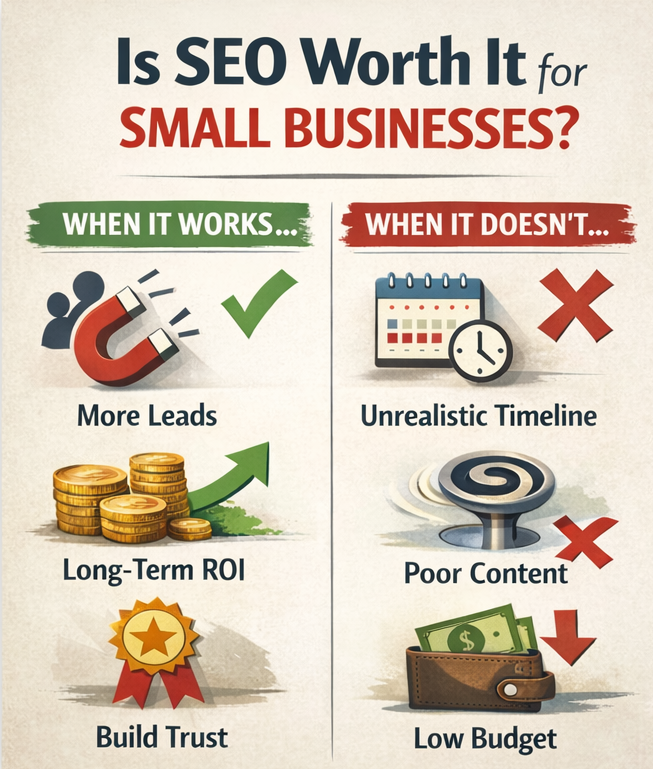
Final Verdict: Is SEO Worth It for Small Businesses?
Yes, it is worth it—when done for the right reasons, in the right way as well as with the right expectations.
SEO isn’t fast. SEO isn’t flashy. But SEO works—quietly, steadily, and compounding over time.
Therefore, if your business is built to last, SEO is worth the investment.

Leave a Reply