In today’s digital landscape, businesses often ask an important question: Is SEO organic marketing or inorganic marketing? The confusion is understandable, especially because SEO is often compared with paid ads, PPC, and other performance-driven strategies.
In this blog, we’ll break down what SEO truly is, how it fits into organic and inorganic marketing, and above all why it remains one of the most powerful long-term digital marketing strategies.
What Is SEO? (Search Engine Optimization)
Search Engine Optimization (SEO) is the process of improving a website’s visibility on search engines like Google, Bing, and Yahoo, that also without paying directly for rankings.
SEO focuses on:
- Keyword optimization
- High-quality content creation
- Technical website improvements
- Backlink building
- User experience (UX)
- Therefore, the primary goal of SEO is to earn traffic naturally by ranking higher on search engine results pages(SERPs).
Understanding Organic Marketing
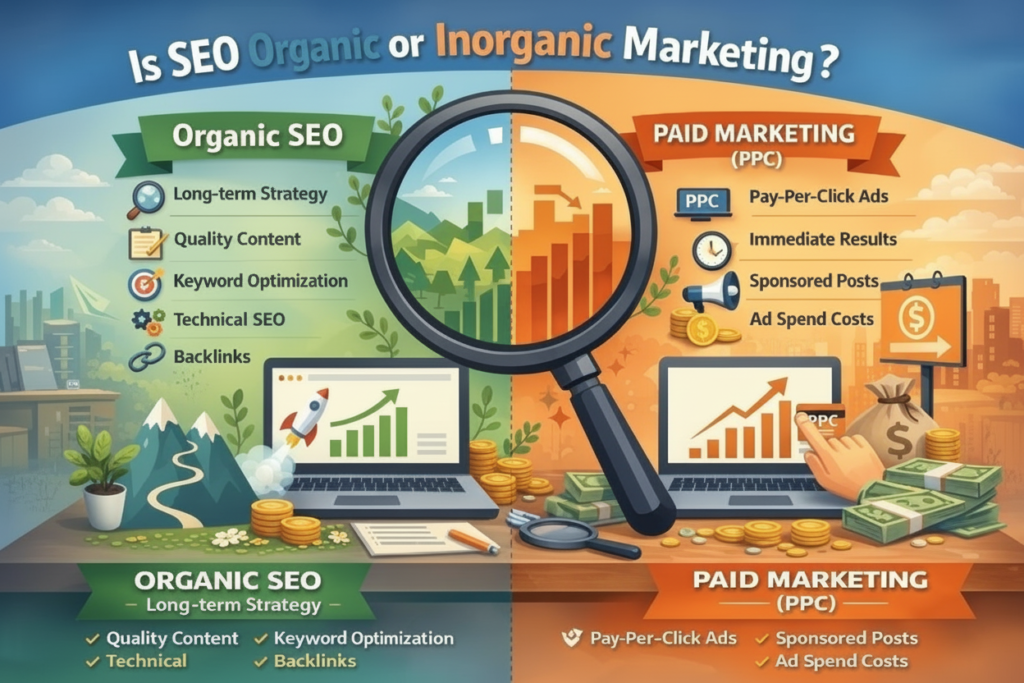
Simply put, organic marketing refers to strategies that attract customers naturally over time without paid
promotion. In addition, key characteristics of organic marketing are:
- No direct ad spend
- Long-term results
- Trust and credibility driven
- Sustainable traffic growth
For example:
- SEO
- Content marketing
- Social media engagement (non-paid)
- Email marketing (non-promotional)
Understanding Inorganic (Paid) Marketing
Inorganic marketing, also known as paid marketing, involves strategies where businesses pay to gain visibility immediately.
For example:
- Google Ads (PPC)
- Facebook & Instagram Ads
- Sponsored posts
- Influencer collaborations (paid)
- Display ads
Key traits of inorganic marketing:
- Immediate results
- Requires continuous ad spend
- Traffic stops once ads stop
- Less trust compared to organic channels
So, Is SEO Organic or Inorganic Marketing?
SEO falls firmly under organic marketing because:
- Firstly, you don’t pay search engines for rankings.
- Also, traffic is earned, not bought.
- Furthermore, results compound over time.
- In addition, rankings depend on relevance, authority, and user experience.
Therefore: SEO is Organic Marketing.
However, the confusion arises because SEO requires investment – in tools, content, and expertise – but not direct payment for traffic.
Why SEO Is Considered Organic Despite Costs?
Many people assume that since SEO involves costs (agencies, tools, writers), it must be inorganic. However, this is a misconception. Here’s why SEO remains organic:
| Factor | SEO | Paid ads |
| Pay per click | No | Yes |
| Long-term value | High | Low |
| Trust and credibility | Strong | Weaker |
| Compounding ROI | Yes | No |
Therefore, you’re paying for effort and expertise, not for placement.
Can SEO Have Inorganic Elements?
While SEO is organic at its core, some supporting activities can in fact feel inorganic:
- Some paid SEO tools such as Ahrefs, SEMrush, Screaming Frog
- Content writers receiving monetary benefit
- Paid outreach for backlinks
But these are facilitators, not ranking shortcuts. Google does not allow paid rankings, therefore, only quality-driven results.
SEO vs PPC: Organic vs Inorganic Comparison
| Aspect | SEO (Organic) | PPC (Inorganic) |
| Traffic source | Search engine rankings | Paid placements |
| Cost structure | Time and effort | Pay per click |
| Sustainability | Long-term | Short-term |
| ROI over time | Increases | Decreases |
| Trust level | High | Moderate |
Why Businesses Should Focus on SEO as an Organic Strategy?
1. Long-Term Growth
SEO builds authority and keeps generating traffic even when active work slows down.
2. Higher Trust
Users trust organic results more than ads.
3. Cost-Effective Over Time
Although SEO takes time, the cost per lead reduces significantly.
4. Better User Experience
Overall, SEO aligns with good UX, fast loading pages, and helpful content.
SEO in a Modern Digital Marketing Strategy
The smartest brands use both organic and inorganic marketing together:
- SEO for long-term stability
- Paid ads for quick wins and campaigns
- Content marketing to support SEO
- Retargeting ads to boost conversions
SEO acts as the foundation, while paid marketing accelerates growth.
Final Verdict: Is SEO Organic or Inorganic Marketing?
Indeed SEO is fundamentally an organic marketing strategy.
It focuses on:
- Firstly, earning visibility
- Also, building trust
- Moreover, creating long-term value
While it may involve costs and tools, SEO does not buy traffic, it earns it. If you or you business requires SEO services then Buzzbaba is the best place you can avail all services at best cost.

Leave a Reply