
Search is no longer the same. Moreover, it will never go back.
Earlier, users searched on Google and clicked links. However, today they ask questions and receive direct answers from AI engines. Therefore, visibility has changed. Ranking alone is no longer enough.
This is exactly where Generative Engine Optimization (GEO) comes in.
After working in SEO for more than 10 years, I can confidently say this: GEO is not a trend.
Instead, it is the next layer of search optimization.
Let’s break it down clearly.
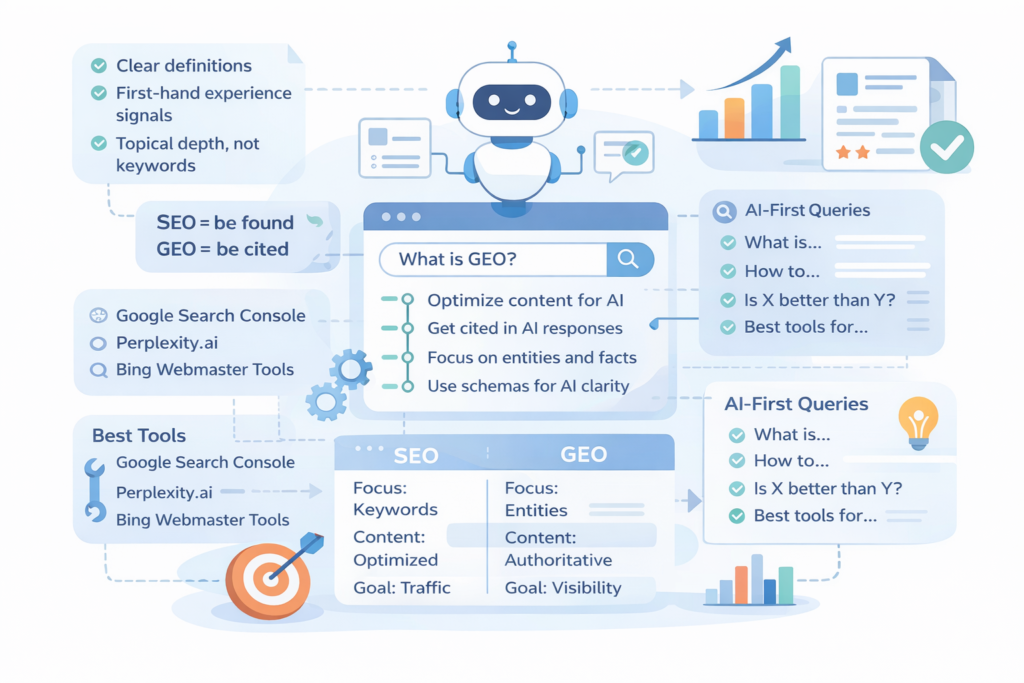
What Is Generative Engine Optimization (GEO)?
Generative Engine Optimization is the practice of optimizing content so AI engines choose it as a source when generating answers.
In other words, GEO helps your content get:
- understood by AI
- trusted by AI
- cited by AI
Traditional SEO focused on rankings.
However, GEO focuses on inclusion in AI-generated responses.
Therefore, the goal is not just traffic.
The goal is authority as well as attribution.
What Is GEO in AI?
In AI systems, GEO means structuring information so large language models can extract it easily.
AI engines do not read content like humans. Instead, they analyze structure, clarity, and factual confidence. As a result, vague content fails.
Moreover, AI prefers content that is clear, specific, experience-backed and logically structured.
Therefore, GEO is not about keywords alone. It is about how information is presented.
Why Generative Engine Optimization Matters Now?
Let me give you a real example:
Case Study: SaaS Website Impacted by AI Overviews
A SaaS client ranked on page one for years.
Traffic was stable.
Revenue was predictable.
Then AI Overviews launched.
As a result:
- Clicks dropped by 30%
- Rankings stayed the same
- AI answers replaced organic clicks
Therefore, the issue was not SEO failure, but AI visibility loss.
After applying GEO:
- The brand appeared in AI summaries
- Mentions increased across tools
- Leads recovered within 3 months
Hence, GEO is not optional anymore.
What Is GEO Used For?
GEO is used to:
- Appear in AI-generated answers
- Build topical authority
- Capture zero-click visibility
- Influence user decisions early
Additionally, GEO helps with:
- Brand recall
- Trust building
- Long-term discoverability
SEO brings users to your site but GEO brings your brand to the user — even without a click.
Is GEO Better Than SEO?
No.
However, it is different.
SEO helps you get found while GEO helps you get referenced.
Therefore, GEO does not replace SEO.
Instead, it extends SEO.
You still need technical SEO, indexing, backlinks and site health.
However, without GEO, your content may never appear in AI answers.
Hence, SEO + GEO is the winning strategy.
Will GEO Replace SEO?
Short answer: No.
Long answer: SEO will evolve.
Similarly, GEO will become part of SEO.
Just like mobile optimization became mandatory, GEO will too.
Therefore, early adopters win and late adopters catch up.
What Are the Basics of GEO?
Before tools and tactics, you need fundamentals.
Clear Entity Definition
AI works with entities, not assumptions.
Therefore, your website must clearly state:
- Who you are
- What you do
- Who you serve
- Why you are credible
Moreover, this information must be consistent across website pages, schema, content and profiles.
Ambiguity reduces trust.
Hence, clarity is critical.
Answer-First Content Structure
AI prefers direct answers.
Bad approach:
“There are many factors to consider…”
Better approach:
“Generative Engine Optimization (GEO) is the process of optimizing content for AI-driven search engines.”
Therefore, always answer first.
Explain later.
Topical Depth, Not Keyword Density
Old SEO rewarded keywords.
However, GEO rewards topic completeness.
AI looks for definitions, comparisons, use cases, examples and also, limitations.
As a result, shallow content loses relevance.
How to Start With GEO (Step-by-Step)
Here is how I implement GEO for real clients.
Identify AI-Visible Queries
Not every keyword triggers AI answers.
Therefore, focus on:
- “What is…”
- “How does…”
- “Is X better than Y?”
- “Best tools for…”
Additionally, test queries in Google AI Overviews, Bing Copilot and Perplexity.
If AI answers it, GEO applies.
Rewrite Content for AI Consumption
This is where most sites fail.
You must use short paragraphs, write clear headings, avoid filler phrases and also, remove vague statements.
Moreover, add:
- Bullet points
- Definitions
- Summaries
AI prefers predictable, clean structure.
Add First-Hand Experience Signals
This is extremely important.
AI engines trust content that shows experience.
For example:
“After optimizing 15 blogs using GEO, we saw…”
That single line increases credibility.
Therefore, generic content slowly disappears.
Implement Schema That Supports GEO
Schema does not rank content but it clarifies meaning.
Focus on:
- Article schema
- FAQ schema
- Organization schema
- Author schema
As a result, AI understands your content faster.
How Do I Do GEO for My Website?
Here is a practical framework.
Homepage GEO Optimization
Your homepage must clearly answer:
- What does this business do?
- Who is it for?
- What problem does it solve?
Avoid marketing buzzwords.
Instead, use plain language.
Moreover, AI prefers clarity over creativity.
Blog GEO Optimization
Every blog should include:
- A clear definition
- Structured subtopics
- Comparisons
- Actionable steps
- Summary section
Additionally, update older posts.
GEO works best on existing authority pages.
About Page GEO Optimization
Include:
- Years of experience
- Industry focus
- Clear positioning
Therefore, your About page directly impacts GEO.
How to Do Geo-Generative Engine Optimization for Content
Here is a real rewrite example.
Before (SEO-only):
“SEO is constantly evolving and therefore, businesses must adapt…”
After (SEO + GEO):
“SEO is evolving because AI engines now generate answers instead of showing only links.”
The second version is clear, factual and quotable. That is GEO.
Best Tools for Generative Engine Optimization
There are no perfect GEO tools yet.
However, these help.
Google Search Console
Use it to:
- Identify impression drops
- Track zero-click queries
Moreover, compare pre-AI and post-AI performance.
Perplexity.ai
Check:
- Who is being cited
- What sources AI trusts
Then reverse-engineer that content.
Bing Webmaster Tools
Bing powers many AI engines.
Therefore, Bing visibility matters again.
Schema Validators
Clean schema improves AI understanding.
Manual AI Testing (Underrated)
Ask AI:
- “What is X?”
- “Best tools for Y?”
If your site is not mentioned, hence, GEO work is needed.
Real Case Study: Blog GEO Optimization
Industry: B2B Services
Problem:
- Rankings were strong
- AI visibility was zero
Actions taken:
- Added definition blocks
- Simplified sentences
- Added experience-based examples
- Improved structure
Results after 90 days:
- Cited in AI Overviews
- Mentioned in Perplexity
- Brand searches increased by 40%
Traffic did not spike.
However, authority increased significantly.
Common GEO Mistakes to Avoid
Avoid keyword stuffing, writing vague content, overusing AI-generated text and also, ignoring human readability.
Ironically, GEO works best when content feels human.
GEO vs SEO: A Practical Comparison
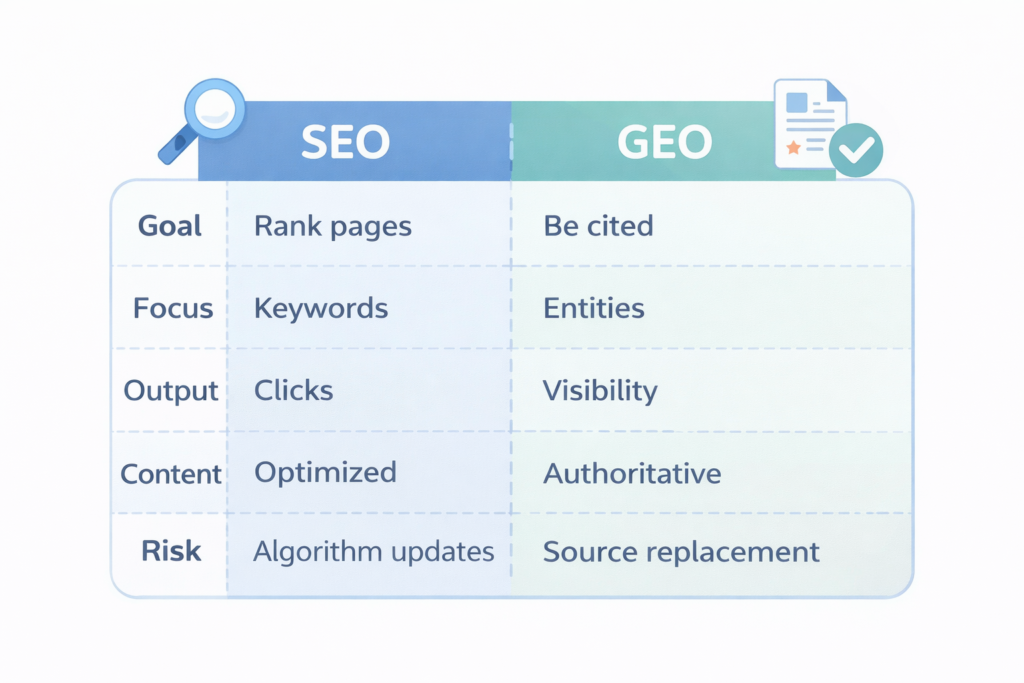
You need both.
Final Thoughts: How to Start GEO Today
If you do one thing today, do this:
Rewrite your top pages to answer questions clearly and directly.
No fluff or filler or guessing.
GEO rewards clarity, experience, and structure.
SEO brought traffic.
GEO will protect relevance.
And in 2026, relevance is survival.

Leave a Reply