
This is one of the most common — and most frustrating — questions I’ve heard in my 10 years working in SEO.
You publish more content. Your pages are longer. You’ve “done everything right.”
Yet your competitor with half the content, fewer pages, and also, sometimes even weaker design keeps outranking you.
This is not accidental, instead, it’s structural.
Google does not reward volume but it rewards impact. Therefore, understanding why competitors win with less content requires looking beyond word count and into how search engines actually evaluate usefulness, authority, and intent satisfaction.
Let’s break this down properly.
Why Is My Competitor Ranking Higher?
In almost every audit I’ve done, the reason is never “because Google is unfair.”
Instead, it usually comes down to one or more of these factors:
- Better alignment with search intent
- Stronger topical authority
- Higher engagement signals
- Cleaner technical SEO
- Smarter link acquisition
- Consistent SEO investment
Moreover, competitors often focus on the right 20% of pages while others spread effort across hundreds of low-impact URLs.
That brings us to the 80/20 rule.
What Is the 80/20 Rule in SEO?
The 80/20 rule (Pareto Principle) in SEO means:
Around 80% of your organic traffic usually comes from 20% of your pages.
Your competitor understands this but most websites do not.
Real Case Study
I worked with a SaaS company that had 420 blog posts but only 38 pages generating meaningful traffic.
Their competitor had 96 total pages and 24 pages driving 90% of revenue-focused traffic.
Why? Because the competitor:
- Updated their top pages every 3–4 months
- Built links only to those pages
- Internally linked aggressively toward them
- Matched intent perfectly
Therefore, less content performed better because it was strategically maintained, not just published and forgotten.
Why 96.55% of Content Gets No Traffic From Google?
This statistic shocks people, but it’s accurate.
Nearly all content published online never ranks, never earns links, and also, never gets traffic.
Here’s why.
Most Content Fails Because it:
- targets keywords with no real demand
- matches keywords but misses intent
- adds nothing new to the conversation
- has no backlinks or authority support
- is never updated
Also, Google doesn’t rank articles. It ranks solutions.
If your competitor publishes fewer but more intent-driven pages, Google sees those pages as more useful — even if they’re shorter.
What Are the 4 P’s of Competitor Analysis?
When I analyze why a competitor outranks someone, I use the 4 P framework:
1. Pages
Which specific pages are ranking — not how many.
Often, a single competitor page ranks for 30–100 related keywordsultiple intent stages, featured snippets and People Also Ask boxes.
2. Positioning
How clearly the page answers:
- Who it’s for
- What problem it solves
- Why it’s better
Vague content loses but clear positioning wins.
3. Performance
This includes page speed, mobile UX, engagement metrics as well as crawl efficiency.
Moreover, even small improvements here compound over time.
4. Promotion
Backlinks, mentions, internal links, as well as brand signals.
If your competitor actively promotes content and you don’t, Google notices.
What Is a Good CTR for SEO?
CTR (Click-Through Rate) is an underrated ranking lever.
A “good” CTR depends on position, but in general:
- 28–35% : Position 1
- 15–25% : Position 2–3
- 08–15% : Position 4–6
If your competitor has better titles, cleaner URLs as well as rich results (FAQ, schema, images), they’ll win clicks — and therefore rankings — even with less content.
Real Example
One eCommerce client I worked with rewrote only title tags and meta descriptions.
Result:
- CTR improved by 31%
- Rankings increased without adding a single new page
Therefore, optimization often beats expansion.
How to Gain Visibility on Google?
Visibility is not about publishing more pages but about occupying more SERP real estate.
Your competitor might rank because they:
- Appear in Featured Snippets
- Dominate People Also Ask
- Rank images and videos
- Own branded search results
Also, they often structure content better:
- Clear H2s and H3s
- Short, direct answers
- Schema markup
- Strong internal linking
Visibility compounds. Once Google trusts a site, new pages rank faster — even if they’re shorter.
How to Increase Your SEO Traffic in 30 Days?
You won’t triple traffic in 30 days. Anyone promising that is lying.
However, you can see meaningful gains by doing the right things.
What Actually Works in 30 Days:
- Updating top 5–10 existing pages
- Improving titles for higher CTR
- Fixing cannibalization
- Adding internal links from strong pages
- Refreshing outdated content
I’ve seen traffic lifts of 15–40% in a month using only optimization — no new content.
Therefore, focus on leverage, not volume.
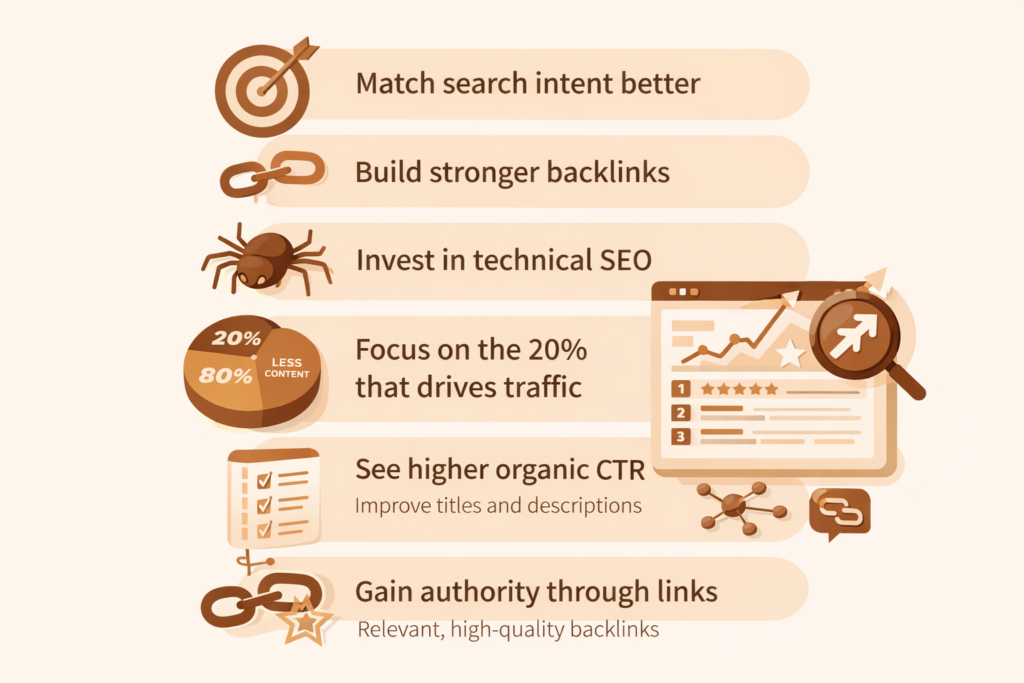
6 Reasons Why Your Competitors Are Ranking Above You
Let’s make this very practical.
1. Better Search Intent Match
They answer the question faster as well as clearer.
2. Stronger Backlink Profiles
Not more links — better links.
3. Content Depth Where It Matters
They go deep on high-intent topics, not everything.
4. Superior Internal Linking
They also guide Google toward priority pages.
5. Faster, Cleaner Websites
Technical SEO still matters more than people admit.
6. Consistent SEO Investment
SEO is ongoing. Competitors who win treat it as a system, not a task.
So, What Are Backlinks and Why Are They Important?
Backlinks are still one of Google’s strongest trust signals.
However, the mistake many make is chasing quantity.
Your competitor likely has:
- Fewer links
- But from more relevant, authoritative sources
- Pointing to fewer, more important pages
Case Study
A B2B site I audited had 1,200 backlinks — but spread across 300 URLs.
Their competitor had 280 backlinks — but focused on 12 pages.
Guess who ranked?
Therefore, link focus beats link volume.
Are Your Competitors Actively Investing in SEO?
This is the final — and often overlooked — truth.
SEO winners are not “lucky” but consistent.
Your competitor is likely:
- Updating old content quarterly
- Building links every month
- Monitoring rankings weekly
- Testing CTR improvements
- Expanding only proven topics
Meanwhile, many sites publish content, wait, and hope.
Google rewards momentum.
Final Thoughts: Less Content, More Strategy
Your competitor doesn’t rank higher despite having less content.
They rank higher because they focus on:
- Intent over volume
- Optimization over expansion
- Authority over activity
If you want to win, stop asking:
“How much content should I publish?”
Start asking:
“Which pages actually move the needle — and how do I make them impossible to beat?”
That shift alone changes everything.

Leave a Reply